

When I was fourteen, one of my mom’s closest friends was engaged to a foreign national from a very wealthy family. That year, I was at a family reunion with my parents and I had to fly back a day early for school, so they arranged for me to stay the night with my mom’s friend and her fiancé. I arrived at the airport and was soon being driven to their condo in his Bentley. Once there, they had made up the couch in the living room for me to sleep.
Directly across from me was a cage attached to the wall. It was about ten feet long, three feet wide, and seven feet high. Inside it was a solitary capuchin monkey. He was never let out because he once bit someone, and that entire night, I stared at him, and he stayed in a corner, staring at me, cowering, and whimpering.
Not too long after that, the fiancé absconded to his native country, taking their five year old son with him, and without my mom’s friend’s knowledge (that’s a whole other story involving international politics). He left behind his cars, his Dali paintings, and the monkey. She didn’t want the monkey to remain and she wanted it to have a much better life, so she placed it with a sanctuary.
I had an opportunity at fourteen to visit that sanctuary and to see the drastic change that can happen when an animal’s environment is improved. Over the last forty years, I have donated over $50,000 to shelters, zoos, animal sanctuaries and other rescue organizations.
I’m not adverse to sanctuaries for pinnipeds and cetaceans, but do I assess them, as I do with any sanctuary, with one simple truth:
A SANCTUARY IS ONLY AS EFFECTIVE AS ITS BOARD AND EXECUTIVE MANAGEMENT ARE
With both its board and executive management, Whale Sanctuary Project (WSP) has proven itself to be highly ineffective, based on a number of criteria. But from one particular standpoint, it has been highly effective, and I was quite surprised when I realized how and why.
A “LEGAL” DISCLAIMER
For the past four months, I’ve been collaborating with a group of third year law students on reviewing all my documentation on WSP from a legal perspective. Keep in mind that these are students who have yet to take the bar exam, yet I appreciate their commitment, time, and feedback, and when they weren’t certain of a legal concept, they consulted their professors and practicing attorneys.
Because of this, they advised me to give what I call the “pharmaceutical disclaimer.” Much in the same way that pharmaceutical companies advise you in their ads not to use a drug without first consulting with your doctor, I’m advising you to please consult with an attorney, preferably one versed in nonprofit business law, before taking any action based on what I’m about to share.
WHAT THE MISSION IS AND WHAT IT ISN’T
For the longest time, I, like many others had assumed that WSP’s mission was to create sanctuaries to house orcas and belugas removed from theme parks and aquariums. However, that’s not the mission. That’s a goal.
The actual mission has been in front of us the entire time.
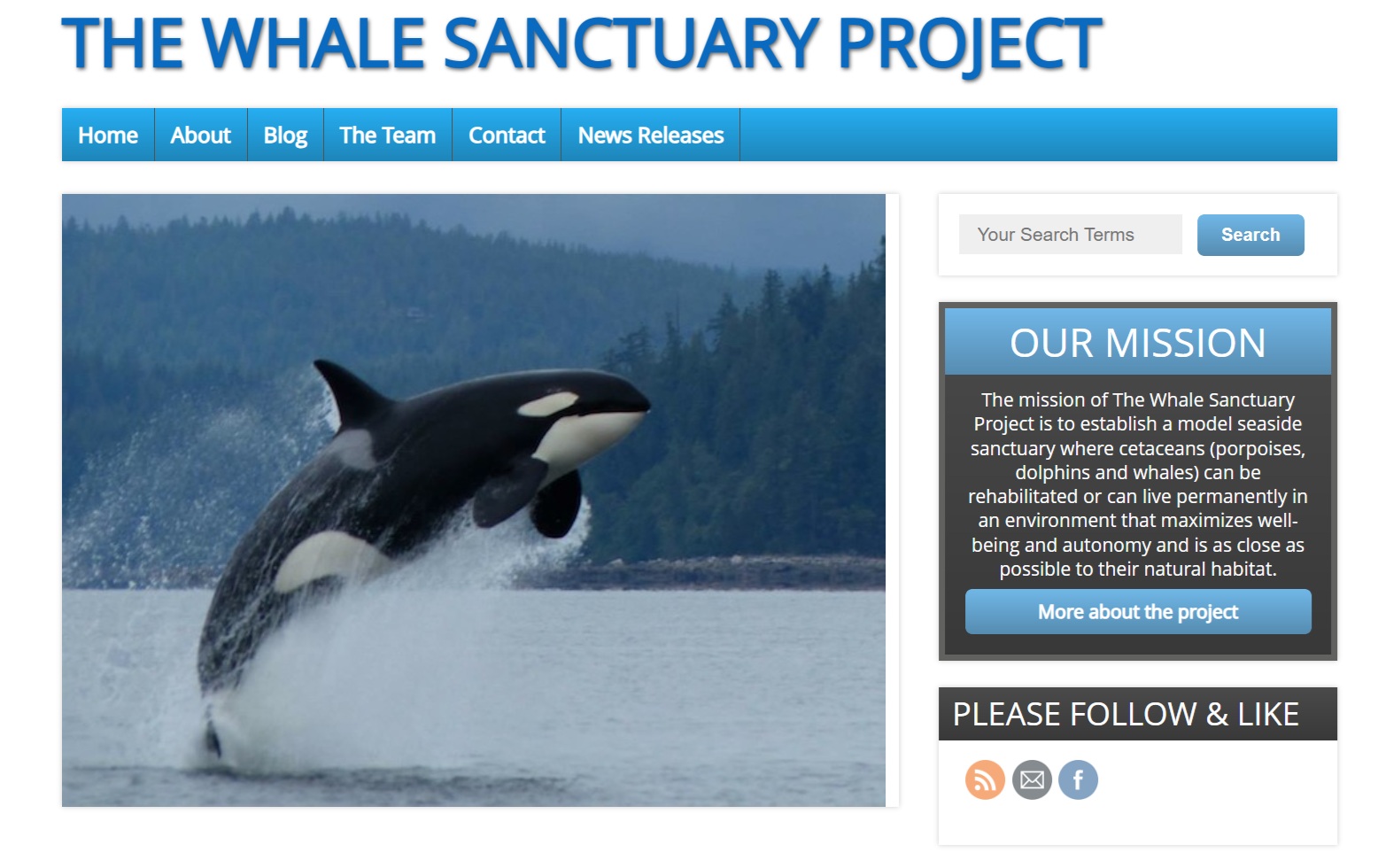
This is WSP’s website on May 8, 2016, only a few weeks after incorporation. The mission statement is right there on the main page.
Here, we see the mission statement as listed on the 2024 tax return, the most recent filed:
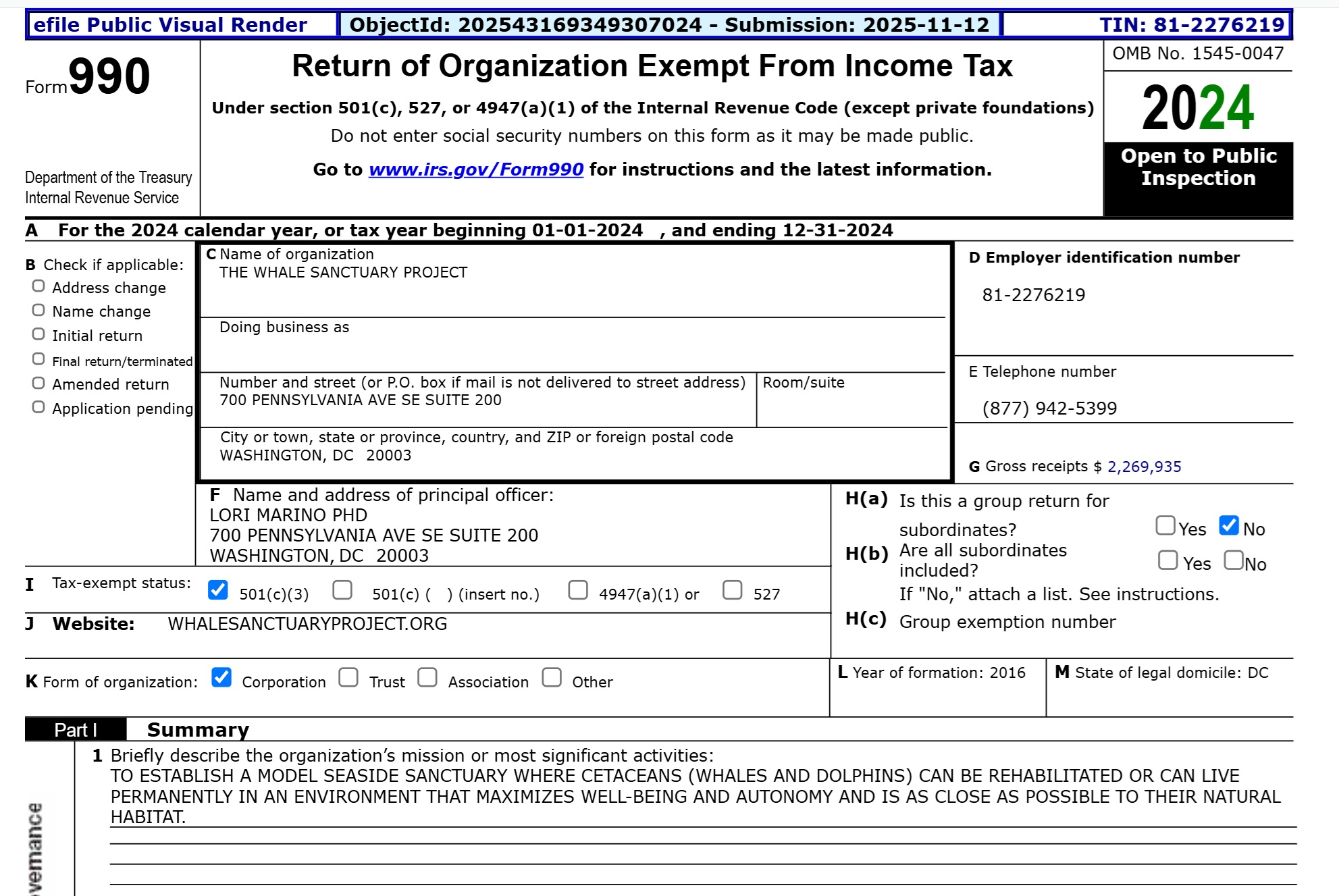
Yes, both do mention dolphins. The core wording for the mission statement has remained the same on the company’s tax releases year after year, although the 2016 and 2017 returns extend the current existing wording with “rehabilitated and returned to the ocean.”
The current public facing mission statement, though possibly not the same one that will appear on the 2025 tax return when filed, is a bit different, but the core wording is still in place. It can be accessed by pressing the “About” button at the top of the organization’s homepage.
We work to transform the way people relate to whales and dolphins by bringing an end to their exploitation and by creating seaside sanctuaries, assisting with international marine mammal rescues, and advancing whale and dolphin science.
All of these variations of the mission statement share two key traits:
- They do not specify that the sanctuary is for captive whales. It’s left open-ended as a rehabilitation facility for whales and a permanent home for whales. It does not state whether these whales are to be sourced from human-operated facilities or from the wild. Additionally, the mission statement currently on the website does not state that the creation of sanctuaries is to bring an end to exploitation. What it does state is that creating sanctuaries AND bringing an end to exploitation is HOW WSP is working to transform the way people relate to whales and dolphins.
- The term “establish” is not limited to opening and operating the proposed sanctuary. Establish also refers to the process of establishing, which includes development, permitting, construction, fundraising, and other activities that will lead to the opening and operation of the facility. One or two activities a year, such as a groundbreaking ceremony, discussions with government agencies, town hall meetings with locals, all constitute part of the establishment process and ensure that WSP is taking action in establishing a sanctuary. It can take forever. I’m familiar with a nonprofit whose mission was to establish a new museum and it took twenty years to finally open it.
To achieve the mission, there need be goals. “Create sanctuaries for captive cetaceans” is a goal that supports the mission. But there’s….
A PROBLEM WITH THE GOALS
During a July 2019 presentation, Charles Vinick, then WSP’s Executive Director and now its CEO, announced that WSP was switching to using stretch goals in its planning.
Stretch goals were designed for profitable businesses that are looking to create new products or revenue streams. Often utilized in concept and blue sky design, companies will place individual teams – not the entire company – in an environment utilizing stretch goals, which often remove budget constraints and milestones, allowing for more free thought and discussion.
We often see stretch goals utilized in appliance and automobile design, theme park attractions, consumer and military electronics, architecture, and medicine, among many other disciplines and industries. Rarely do we see it implemented by an organization developing a sanctuary because milestones are SUPER IMPORTANT in order to ensure the facility is ready to host candidate animals on which fundraising is based prior to their deaths.
So, this means that WSP has no definitive timeline and no definitive budget, that they can all be in flux, easily removed, changed, or replaced. And even though this isn’t what stretch goals were designed for, there’s nothing illegal about them using it, which is why….
SALARIES, CANDIDATES, AND TIMELINES DON’T MATTER
If the mission was actually about building a sanctuary for captive whales, it could be considered that executive management compensation is too high based on the fact that after ten years, a sanctuary doesn’t exist. That would be appropriate on a merit basis.
But that’s not the mission. When we consider that the actual mission does not specify opening and operating a sanctuary, and is limited to “establishing” one, and that the organization is using a goal system that eliminates time and action specific milestones, salaries and compensation must be looked at differently.
As WSP is a virtual organization, we can look at the executive compensation and compare it to the salary range in local markets for similar nonprofit positions.
Charles Vinick’s compensation has continuously been on the low end, often at or below the minimum average salary, for a nonprofit CEO in Santa Barbara, California
Matt Maraynes’ $100,000 in 2014 is below the minimum average salary for a COO in the New York region.
While frowned upon, it is not illegal for a Board President of a nonprofit to receive a salary. If this is the case with WSP, Lori Marino’s compensation is below the average for a nonprofit President in Utah. If the compensation is for services rendered as a consultant outside the scope of Presidential duties, then she’s charging $6,000 per month, which is very low for a consultant on this type of project.
Because of the way the mission and goals system are actually structured, we could not find any malfeasance with the executive compensation.
As long as WSP mentions candidate whales and timeframes in a tentative manner, with phrases, such as “we hope,” “we’re planning,” “we’re attempting,” etc., they are not definitively committing to either obtaining a specific cetacean or having the sanctuary open on a specific date. In those instances where WSP or its management or representatives made a definitive statement, it can be dismissed as an error as long as such a statement is not the norm.
Here’s a fun one. Even though WSP and Friends of Lolita/Friends of Toki were closely tied both financially and operationally – aspects that should be investigated – any comment that Vinick made between February 2022 and January 2024 about Tokitae, the orca at the Miami Seaquarium, should be considered having been made solely on behalf of Friends of Lolita/Friends of Toki, which was a legally separate nonprofit organization from WSP, UNLESS he specifically stated that he was making the statement in his role as a WSP executive.
One thing I will compliment WSP on is that when they’re honest, they’re really honest. While they tend to embellish their role in their Whale Aid programs, something I understand, as it’s a key component for fundraising and supports the mission, they have also been very open about failures – deaths of J50, Tokitae, Timmy, and issues with working with government and third parties, such as in Russia and Germany. But the embellishments do not appear to be enough to constitute fraudulant activity.
WSP’s mission statement, while simple, is well thought out in order to provide legal protections for the organization. I assume that it was composed by the late Don Bauer, who had served as WSP’s General Counsel (and who Marino called the unofficial fifth board member, even though there was for a while an actual fifth board member, but that’s for Part 2).
It’s important to understand this concept behind the mission statement’s wording because any complaints to government agencies, any government investigations of WSP are less likely to be responded to by Vinick and Marino, but rather by….
THE ATTORNEYS
I am amazed at the extent to which WSP is associated with the legal community. If you take the two men who ran the Free Willy project out of the equation (and one, I should note, was behind a multi-million dollar lawsuit against SeaWorld alleging marketing fraud), you’re left with two WSP board members with significant legal ties.
The Animal Welfare Institute, where Dr. Naomi Rose works, has seven practicing attorneys on its inhouse legal team. One of them, Georgia Hancock, is Director of the organization’s marine wildlife program, which makes her Rose’s immediate boss.
Lori Marino has taken on keeping the spirit of the late Steven Wise alive by entering the world of animal welfare law academia, teaching at a number of institutions of higher education. She is well connected within the animal welfare legal community and, I’m assuming, has an army of students able to research issues that she needs answered.
Whale Sanctuary Project has an affiliated nonprofit in Canada, called Whale Sanctuary Canada (WSC), which is (on paper) responsible for the development and operation of the sanctuary. The WSC board is comprised of five members – two of which are Charles Vinick and Lori Marino. The other three are residents of Nova Scotia and are, well, you guessed it, attorneys at law. One of them, Wilfred Moore, also provides WSC and WSP extensive connections within the government of Canada, having represented Nova Scotia in the Canadian Senate from 1996 to 2014.
If you’re planning on filing a complaint with a government agency, don’t do it thinking you’ve outsmarted Vinick and Marino. Investigators are either going to be speaking with very knowledgeable and clever attorneys, or those attorneys are going to be in the room with Vinick and Marino when they’re questioned. Take the time to consult an attorney yourself before taking the drug.
WHY HAVE I HAD CHANGE OF HEART?
I haven’t. A change of perspective is not the same thing as a change of heart. I’ve taken this new legal lens and combined it with what I’ve already learned about WSP’s business and marketing approach to get a more holistic idea of what the heck they’re doing.
And what the heck they’re doing is the biggest issue. Instead of having experienced executive management with a high record of success oversee an animal welfare organization developing a project costing in the tens of millions of dollars, WSP operates as a grassroots animal rights organization on a shoestring budget. Instead of actually constructing and operating a sanctuary, so far it appears they’ve been using the POTENTIAL of building a sanctuary to bring attention to one key fact that they preach – captivity is bad. It’s no different than PETA running a billboard or a video with a celebrity in a bathtub.
It is my belief that the legal protections put in place by Don Bauer and other attorneys within the framework of the mission statement allows WSP to maintain a secondary agenda that is not presented publicly. It is a belief that is supported by extensive documentation on the organization’s business practices and history.
And if this secondary agenda truly exists, then everything changes.
Next time.
TOP IMAGE: Concept image of the sanctuary’s temporary sea pen presented by WSP to the French government.

