

We’ve reached a fork in the road.
To the left is Lori Marino telling KING 5 Seattle that whales and dolphins fail to thrive in an impoverished environment, which results in brain damage.
To the right, Marino is telling the Washington Post that “an orca has a larger portion of its brain devoted to higher thinking than a human does . . . She [Tokitae] was coping in a way that she had worked out for herself. There was a narrative there, a story she told herself about what was happening to her, and that allowed her to live.”
Do we go to the left or to the right? Each route taken leads to a different narrative. Or do we consider them both to be true, treading a third path through the forest ahead – Tokitae suffered brain damage, but compensated by using the part of her brain devoted to higher thinking?
We encounter many conflicting statements from a single source. There are also times where the statements may seem to conflict, but are in fact two parts of the same concept.
We are on a search for what happened to the Miami Seaquarium – a process that took decades, but only a couple of years to reach its devastating crescendo. Along the way, we encounter problems to solve, such as the above. Keep in mind that some of the matters that will be explained below are in the early stages of investigation. As more documentation and testimony are unveiled, the narrative may change.
Misconceptions and Revisionism
There are misconceptions within the public realm, such as the importation of Faropenem from Japan, which a number of people believe was an importation unique to Tokitae. In fact, the drug had been imported and used for over a decade with other orcas at North American parks.
There is an attempt to revise history about the Seaquarium and what took place. The recent Washington Post article on Tokitae states of the relationship between The Dolphin Company and Friends of Toki (FOT): “The resulting partnership was unprecedented: It was the first time a marine park owner had agreed to work with people who might be considered activists, [FOT co-Founder Charles] Vinick said. ‘What was this collaboration based on? It was based on identifying an area of mutual agreement, on being able to respect one another, and speak with one another as collaborators and even partners, without worrying about all the things we disagree about.'”
If we roll back the clock almost eight years, we encounter the actual first major partnership between a marine park owner and “people who might be considered activists,” the short-lived partnership between SeaWorld and the Humane Society of the United States. Though Joel Manby nor Wayne Pacelle soon parted ways with their respective organizations, commitments were made to end the breeding of orcas at all three US SeaWorld parks and to not exhibit them in any new parks, including international locations. To date, the breeding ban has continued and the first international SeaWorld park opened earlier this year in Abu Dhabi, with, true to the commitment, no orcas.
Even after Manby’s departure, additional welfare changes were instituted at SeaWorld under the Chairmanship of Scott Ross, including the elimination of water work with belugas and an end to placing feet on cetacean rostrums.
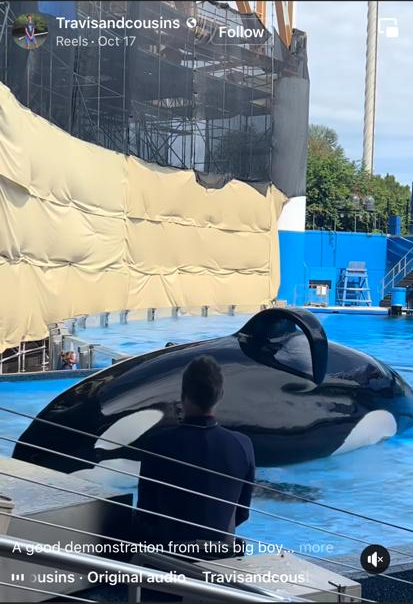
That does not mean SeaWorld is infallible. The Orlando park has recently been doing some much needed and well-publicized repairs to its orca stadium grandstand, yet remains silent on peeling paint in the orca stadium’s pools. Just last year, a trainer was seriously injured when removing paint chips from the mouth of an orca as it was attempting to ingest them, an act that was documented by two different federal agencies. Often, the easiest way to prevent paint from peeling is to attach Star Board over those sections, as illustrated in this 2018 photo from the Orlando Sentinel.
Journey to Cypress Island
Sometimes, our research is incomplete because we don’t have access to necessary documentation.
One such instance involves the relocation project for Tokitae, which involved both Washington state and federal agencies.
At the time of Tokitae’s passing, no permits had been applied for with any agency.
And that’s a good thing.
You may be surprised by what we’re about to share. The key to putting together the clues is to remain objective. That means we have to put our personal feelings aside.
Based on when the process began, had there been permit applications so soon, it would have been a serious red flag. The permitting process can be thought of as comprising three sections: an exploratory process, an action plan, and then permit application.
So, it’s good that Friends of Toki was not rushing the permitting. And they weren’t rushing the action plans either. On December 4, 2023, a spokesman for the Marine Mammal Commission wrote us: “The Marine Mammal Commission is unaware whether a final action plan was ever prepared by the Miami Seaquarium or Friends of Toki for moving Lolita or whether such a plan was ever submitted to the National Marine Fisheries Service. Since the killer whale in question was taken into captivity prior to enactment of the Marine Mammal Protection Act, it remains unclear what authorizations would have been required for moving the animal or whether the Commission would have had a role in the review. In any event, no action plan was ever filed with the Commission and, as such, we cannot provide you a copy, whether requested informally or pursuant to FOIA.” As for National Marine Fisheries Service (NOAA Fisheries), the Tokitae FAQ on the agency’s website indicates that no action plan was received prior to her passing. Again, a good thing.
Through document requests and correspondence with the State of Washington Department of Natural Resources (DNR), NOAA, the Marine Mammal Commission, and the Army Corps of Engineers, we were able to develop a rough timeline.
On February 1, 2023, activist Lloyd Lytle, made an email introduction between Charles Vinick, project manager for Tokitae, and Mike Rechner, Assistant Division Manager, Aquatic Resources, Washington DNR. A Zoom call was scheduled for February 13, which needed to be rescheduled due to surgery.
There was an official meeting between Friends of Toki on May 3 with Washington’s integrated agency taskforce (ORIA), then, on May 17, ORIA received an official request to begin the project scoping and coordinated permit process. Additional meetings between FOT and ORIA were conducted in June and/or July (it is difficult to tell from released emails if there were separate meetings in each month or if the June meeting was rescheduled to July).
By July, 48North Solutions, contracted by FOT, was in direct communications with DNR and ORIA. Much of their correspondence was about the Cooke Aquaculture location at Deepwater Bay, Cypress Island, as a potential site for the sea pen. Deepwater Bay had also been one of the Whale Sanctuary Project’s preferred locations for a Pacific Northwest orca sanctuary back in 2019.
One of the biggest problems with piecing together the timeline is the differing accounts by participants. Based on the press release issued on March 30, 2023, we used the published timeframe of 18-24 months from that date, which would have placed Tokitae in the Washington sea pen by Spring 2025, placing Friends of Toki at exactly the point in the permitting process they should have been when she died. Had this carried through, she would spend two hurricane seasons in a less than optimal tank before the move would have taken place. This timing also coincided with the currently approximated opening of the whale sanctuary in Nova Scotia, that is until that sanctuary opening timeframe is revised yet again.
However, funder Jim Irsay gave a differing timeline, expecting Tokitae to be relocated by the end of 2023, with the added expectation that this would not just be a relocation, but a release into the wild to live with her pod. Recently, the Chairman of the Center for Whale Research showed support for the Irsay plan.
One of the questions we’re unable to answer at this point is: “what prevented FOT from beginning the exploratory process sooner?” Its sister organization had already done substantial scoping of government agencies during the 2019 proposal to develop a Pacific sanctuary and for the Tokitae relocation plan it developed for the Lummi. The answer to the question is tied up in the confidential agreements between the four participating parties – Irsay, The Dolphin Company, Friends of Toki, and Miami-Dade County.
Three Little Words
Another issue we sometimes encounter is the opposite of not having information. It’s having too much information and discerning what is pertinent and what is superfluous. This is where putting the wrong clues together could lead us down a rabbit hole into conspiracy country. Do conspiracies exist? Yes. Yes, they do.
Will Elgar.
Director of Zoo Miami
Two term president of the International Marine Animal Trainers Association (IMATA).
Is Elgar part of a conspiracy or is he just a crafty individual who took advantage of the system?
We really wouldn’t care about Elgar except for one thing – he went before the Board of County Commissioners, announced himself as President of IMATA and an inspector for the Alliance of Marine Mammal Parks and Aquariums (AMMPA), and implored the Board to vote in favor of transferring the Miami Seaquarium lease to The Dolphin Company, which he said had a great tradition of conservation and animal welfare and that doing so would beckon in a new age of accountability and transparency.
And that obviously didn’t happen.
Four things struck us as odd for not being included in Elgar’s testimony (a fifth odd thing would be the jittery hands in need of a fidget spinner):
- More than a third of the training programs accredited by IMATA are at facilities owned or controlled by The Dolphin Company.
- Approximately a quarter of AMMPA accredited facilities fall under The Dolphin Company umbrella.
- Elgar’s wife, who is a reputable trainer in her own right, was an employee of the Miami Seaquarium.
- The Mayor introduced Elgar as being the former Director of Zoological Operations at the Georgia Aquarium.
Why is this last one odd? We’ll explain in a moment.
Press releases from the County and the Zoo announcing Elgar’s hiring as Zoo Director used the same phrasing – “Director of Zoological Operations” We wanted to see if the same term was used in his application, so we asked the County, and they sent us resume.
When we reviewed it, things were even odder. Elgar’s resume mentioned his role with a $40 million sea lion habitat which opened in 2016. There was no mention at all of the $125 million shark exhibit which opened in October 2020.
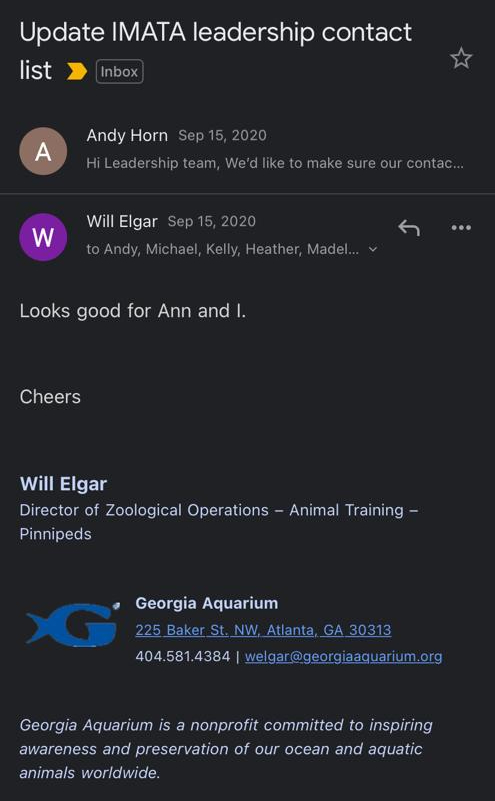
And the portion of the resume covering his time at Georgia Aquarium felt very mundane for a high ranking aquarium official. That’s because there were three little words missing – the same three words that appeared in the 2019 AZA Program and the same three words that were appearing in his email signature in September 2020, “Director of Zoological Operations – ANIMAL TRAINING – PINNIPEDS” (capitalized for emphasis). Once the three words were placed back into the title, the job description worked quite well. It’s important to note that Elgar did not lie on his resume. He simply left out the fact that his role did not encompass the entire aquarium, but was limited to overseeing the care and training primarily of sea lions.
Human Resources expert Jason Bruck has an explanation, which he shared on the ThemedReality Facebook page: “At Georgia the individual heads of the different mammal groups are all called Directors (Senior Directors to be precise). It is more accurate to say ‘a’ director rather than ‘the’ director, however, Will did have management experience with cetaceans at other facilities.”
But there is a Senior Director of Zoological Operations (a single one, not multiple ones as Mr. Bruck, SHRM-CP, has inaccurately stated) named Dennis Christen, who has been with the aquarium since 2006 and oversees all aspects of mammal and bird care, and Mr. Christen reports to Eric Gaglione, the Vice President of Zoological Operations. Elgar was in neither of these leadership roles – he was “a” director of animal training – pinnipeds.
For comparison, the county also sent us the resumes for the two other finalists for the position. We’re not saying that one is necessarily better qualified than the others, but these are clearly the resumes of zoo directors and not of the lead of a single department.
According to an internal memo from Miami-Dade Parks, Recreation, and Open Spaces (PROS) Director Maria Nardi to Mayor Levine Cava, Elgar was fully vetted and his references checked out.
We’d like to know who those references were. Could one of them have been former IMATA President Shelly Wood?
Why did Elgar get the job? Was he placed there to encourage a change of ownership of the Seaquarium to The Dolphin Company, which happens to be the largest overall member of IMATA and the Alliance? Was it because he came from the glamourous Georgia Aquarium? How thorough was the vetting and how many people helped him sweep those three little words – “animal training – pinnipeds” – under the rug?
There have been a couple of interesting developments since Elgar took the job. The county has started removing support for a waterpark that was to be built in the zoo’s parking lot, which had been deemed necessary to build in order to offset the zoo’s financial losses – its annual budget is twice its revenue. There have also been a number of high profile animal deaths at Zoo Miami during this period.
In Sacramento, which we’re using as a counterpoint because ThemedReality is based in Sacramento, Jacobs has been relocating some of the animals from the 14.7 acre Sacramento Zoo to other AZA facilities better suited to meet their needs, all while spearheading the efforts to build a new 65-acre replacement campus with substantially larger habitats than the zoo is currently able to house.
There’s one other thing about Elgar. The county also shared his Bachelors degree transcript with us. When we saw it, and noticed only one grade higher than a C, we contacted Kingston University in London to see if the grading scale is reversed in the UK from what it is in the United States. It is not. These are the equivalent grades.
The problem with analyzing Will Elgar is determining what’s important to the story of the Seaquarium and what’s not, because there are too many elements raising red flags. When he testified before the Board of County Directors, he did so as the Zoo Director, the former Director of Zoological Operations at Georgia Aquarium, the President of IMATA, and as an inspector for the Alliance. He was representing all, and that means that the role of each and every one of them – the County (which owns Zoo Miami), Georgia Aquarium, IMATA, and Alliance, must be looked at.
Just like former IMATA President Shelly Wood, and her relationship with Elgar need to be examined. Her firm, ABC Animal Training, conducts its sessions at parks owned by The Dolphin Company. I wouldn’t blame her. Her husband is one of the founders of TDC and a major shareholder. And TDC is a major stakeholder in IMATA.
You Can Help
To understand the decline of the Seaquarium to the point where it now exists- where animals can be kept in substandard conditions in condemned facilities, where there is a disconnect between veterinarians and trainers, where the health and safety of both animals and staff is at risk, we have to go back a decade in the historical record, and in some cases even farther. We are investigating a decades-long systemic failure of the systems intended to protect those residing in and working at the Seaquarium, a failure perpetrated by members of the very government agencies charged with providing protective oversight of the facility, by the companies that ensured county officials that the utmost standards would be kept, and by the industry tasked with self-policing its own standards of welfare and facility upkeep.
Our goal with investigating the Seaquarium is twofold – to place accountability on responsible parties for the degradation of the park and to create preventative measures to ensure such an occurrence does not take place again on U.S. soil. To that end, we are in constant communication with legislators and officials from regulatory and law enforcement agencies on the federal, state, and local levels; we continue to obtain FOIA, court, and other government documents; and we are in discussions with professionals who witnessed undertakings involving the park.
We are far from done. What we’re doing, we do voluntarily. We get no pay for it. It takes a lot of time – time that’s taken from our paid work, which pays the bills, and time taken from our families – which include children and pets we don’t want to neglect. We pay the fees for FOIA requests and court documents directly from our pockets. This is why we have a fundraiser – any amount helps – to reimburse for those out-of-pocket fees and to finance a trip to Miami to obtain additional documentation that we can only acquire in person and to meet with government officials. If you would like to help, please visit:
https://fundrazr.com/getevidence?ref=ab_4Ck8Nf_ab_4QiqKTe3WK94QiqKTe3WK9

