
by Joe Kleiman, The Flip Editor in Chief
When I took economics in college, my instructor for both micro- and macroeconomics was a lovely woman from Tianjin, China, Professor Chen. The very first thing we learned in each class on the very first day was an ancient saying in Chinese:
授人以魚,不如授人以漁 (transliterated as “Shòu rén yǐ yú, bùrú shòu rén yǐ yú”)
You’ve probably heard it by your English translation: “Give a man a fish and he eats for a day, teach a man to fish and he eats for a lifetime.”
With this phrase, Dr. Chen engrained within all her students that she was not there just to give facts. She was there to teach the process of understanding and finding connections between the facts.
With that in mind, I’d like to take you on a fishing expedition to share how I’m able to discern issues within Whale Sanctuary Project’s (WSP) financial reporting. It’s my hope that you can take this skill and find other inconsistencies within the filings, and better yet, find ones that I missed.
Understanding education and outreach programs
As WSP has never publicly released detailed financial reports, we can only rely on its tax returns, within which lie a treasure trove of problematic information. We’ll be looking at one particular project expense on WSP’s form 990 from 2022, “education and outreach.” I’ve selected this one because it’s the category I have extensive experience with.
Managing IMAX theaters, museums and performing arts companies, I have worked closely with local educators, spoken at schools around the country, and even financed and helped develop student art shows. I’ve worked with professional educational consultants on the development of curriculum to accompany films and museum exhibits. You’ll see my credit at the end of this educator’s guide for an IMAX film, one of a number my name appears on:
Articles I’ve written on museum education have been published in The Planetarian, the publication of the International Planetarium Society, as well as the Informal Learning Review, and numerous other publications. I’ve also been a member of education committees with nonprofits and industry associations. Most importantly, I’ve created budgets and P&L reports for the divisions I managed at both commercial and nonprofit institutions and have contributed to the formulation of nonprofit tax returns.
So, yeah, I have a bit of knowledge about what I’m about to present.
One lesson Professor Chen taught is that no matter how much an expert you think you are, it’s always beneficial to engage a variety of experts in their fields. With that in mind, I reached out to teachers, professional curriculum developers, and consultants who work with nonprofits in developing education and outreach programs. I was concerned by what I had determined on my own, but I became more concerned after these professionals looked over the returns with me and shared their observations.
Some things to know in advance
We’re going to be concentrating on page 2 of the 2022 form 990, where the program expenses are located.
While we won’t concentrate on the first program expense, you should be aware that it combines what should be two different program expenses into a single one. In 2022, WSP served as fiscal sponsor for Friends of Lolita. This means that all donations from Pritam Singh (and possibly others) for Friends of Lolita were given to WSP. All of Friends of Lolita’s expenses for the year were then paid by WSP.
This Friends of Lolita fiscal sponsorship should have been listed as a third, separate program expense.
However, with Friends of Lolita’s expenses being combined with expenses for the Nova Scotia sanctuary, it is impossible on the tax filing to determine exactly how much money went to each program. And because the two are combined, it’s impossible to tell if any public donations intended for the Canadian sanctuary were rerouted to Miami.
You’ll note that the program expense mentions “OUR CURRENT WHALE AID PROGRAM WHALE AID TOKITAE,” which is interesting because the form 990 is dated July 2023 and in an October 2023 FAQ added to the group’s website, we find this statement: “While members of the Whale Sanctuary team participated in the work of Friends of Toki, it was not a Whale Aid project.”
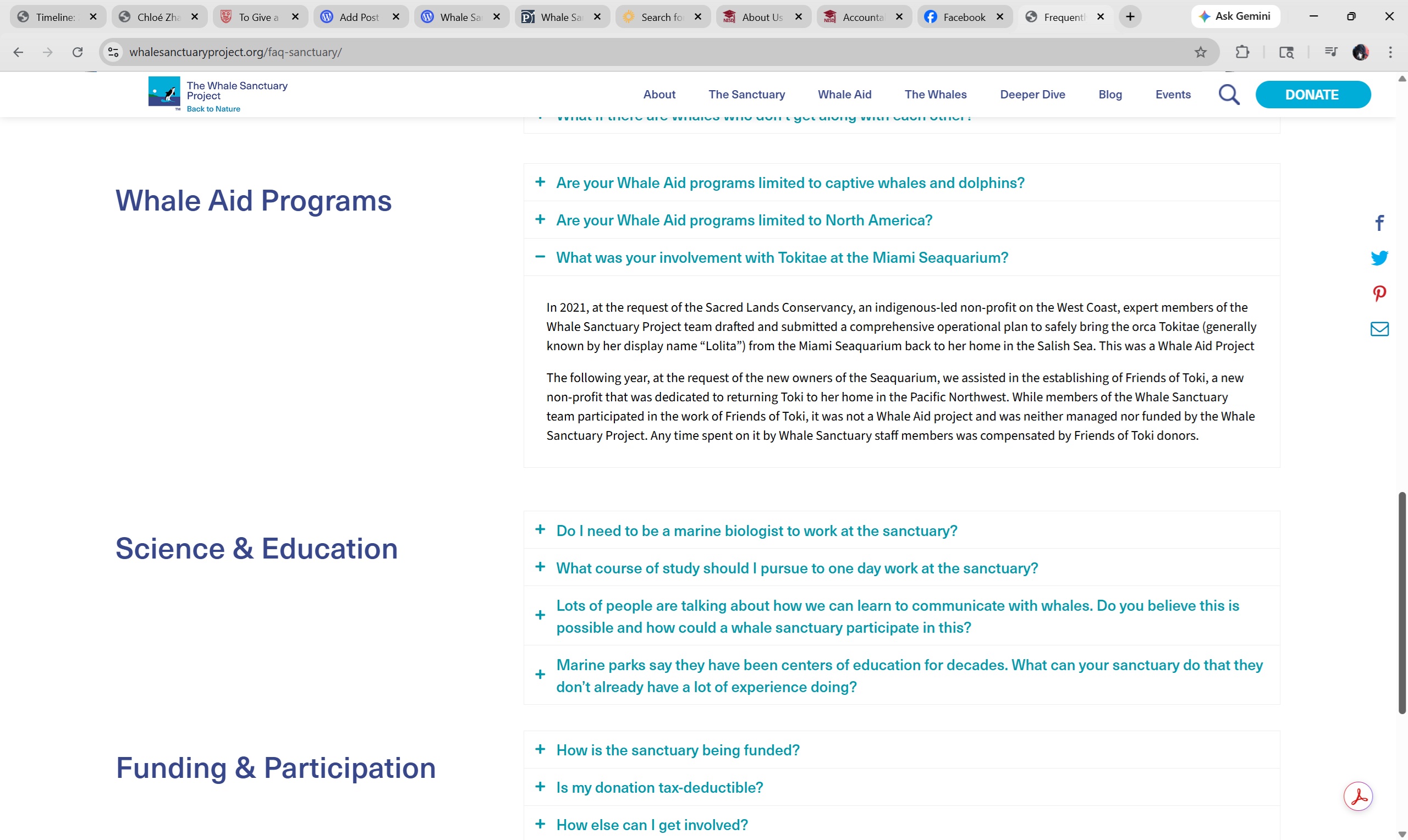
But there’s also a timeline that was added to the website in on the exact same day as the FAQ that reads: “As part of our Whale Aid program, WSP is providing advice and expertise for the purpose of addressing Tokitae’s health and welfare needs.”
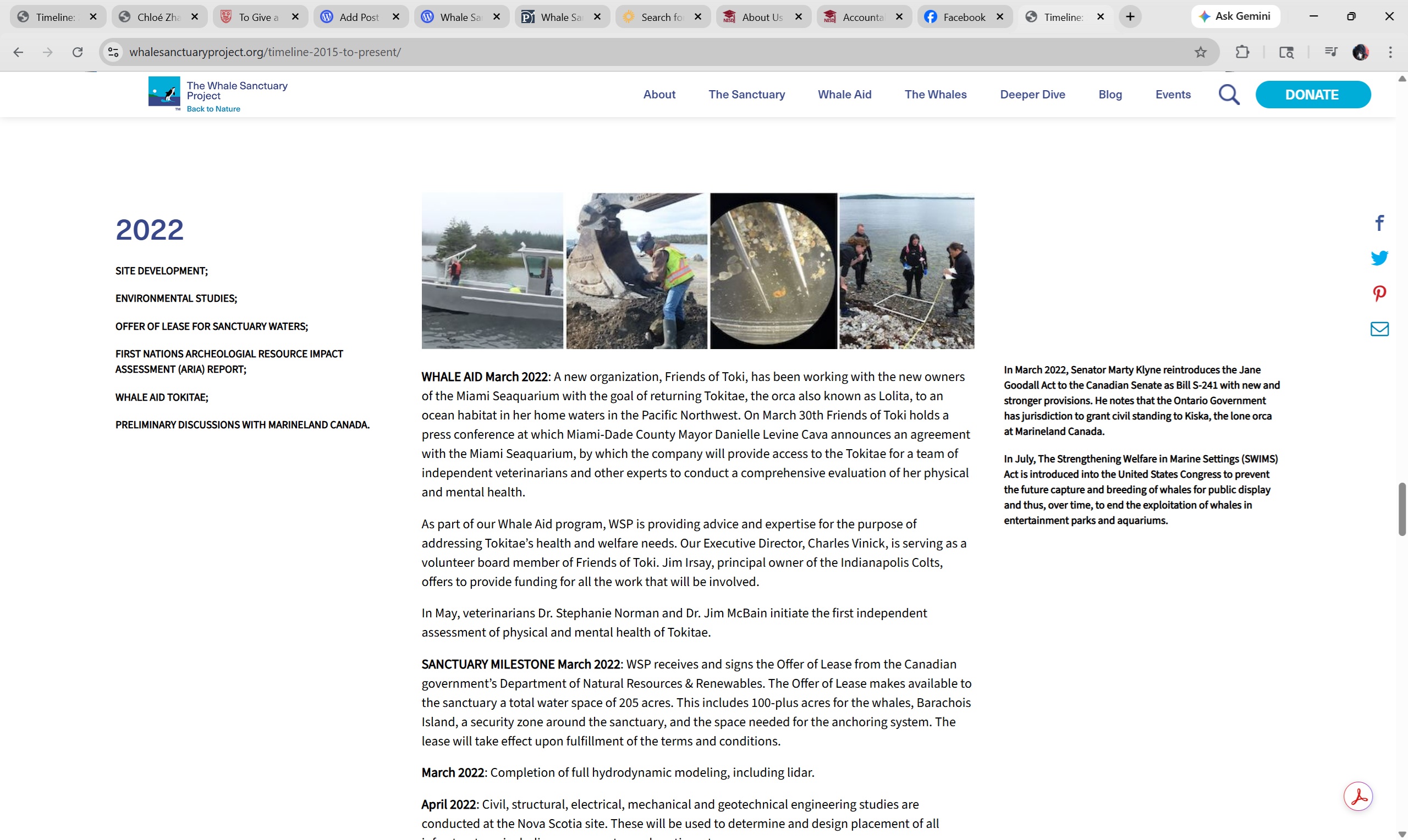
Literally on the same day, WSP added two different pages to its website, one stating emphatically that WSP’s involvement with Tokitae was a Whale Aid program, the other stating emphatically that it was not.
Why does this matter? If you look at the other Whale Aid programs, they have either involved the use of the organization’s funds or they have involved clients paying for Whale Aid services. If it was Whale Aid, then that could imply money going in or out of the Miami project on top of and independent of the funds in the fiscal sponsorship.
But it’s not my intention to examine the first program expense in detail. We’re on to the second.
Costing it out
This is our description for education and outreach:
4TH-GRADE STUDENTS AT SCHLUTER ELEMENTARY IN HASLET, TEXAS, PRESENTED A REMARKABLE ART SHOW ENTITLED “SHOWCASE ART NOT WHALES AND DOLPHINS.” THE PRESENTATION WAS PART OF AN ONGOING PROGRAM ON THE PART OF THE WHALE SANCTUARY PROJECT TO TEACH PEOPLE OF ALL AGES ABOUT THE COMPLEX INTELLIGENCE, COGNITIVE ABILITIES AND EXTENSIVE EMOTIONS OF WHALES AND DOLPHINS. THE STUDENTS’ PRESENTATION LED TO THE DEVELOPMENT OF A CURRICULUM – “WILD FOR WHALES” – BY ONE OF THE TEACHERS, WHO HAS MADE IT AVAILABLE TO SCHOOLS IN OTHER PARTS OF THE UNITED STATES AND CANADA. OUR EDUCATION PROGRAM INCLUDED TALKS TO STUDENTS OF ALL AGES AT SCHOOLS AND COLLEGES. WE ALSO CONDUCTED WEBINARS WITH WHALE EXPERTS, PHILOSOPHERS, ARTISTS AND EDUCATORS ON TOPICS THAT EXPLORED HOW, LIKE US HUMANS, CETACEANS ARE SELF-AWARE BEINGS WHO SHARE STRONG EMOTIONAL AND SOCIAL BONDS AND LIVE ACCORDING TO CULTURAL TRADITIONS.
This all amounts, according to the 990, to $109,567.
At first glance, that seems extremely high. Which is why I asked the experts to help me cost it out and this what we determined:
4TH-GRADE STUDENTS AT SCHLUTER ELEMENTARY IN HASLET, TEXAS, PRESENTED A REMARKABLE ART SHOW ENTITLED “SHOWCASE ART NOT WHALES AND DOLPHINS.”
Step 1: Determine how many 4th-graders attend Schluter Elementary. The easiest way to determine enrollment is to contact the school district directly. But what if you can’t? That’s where we come up with an estimate. There are a number of commercial data sites, but the number can vary, so we opted for a government website for accuracy, which we located by doing a google search with the name of the school and the word “enrollment.” This brought us to a federal agency, the National Center for Education Statistics, which lists fourth grade attendance at Schluter Elementary during the 2024-2025 school year at 111.
Step 2: Estimate 2022 attendance. It’s fair to say that fourth grade enrollment at Schluter in 2022 was likely in the 100-120 range. To err on the side of caution, we estimate it at a mean enrollment of 110.
Step 3: Estimate cost of art supplies. According to teachers I spoke with, art supplies tend to run $50 per student per year on the short end and $100 per student per year on the high end. We estimated the cost per student for art show supplies, if they were not already included in the annual cost, would max out at $50.
Step 4: Cost out art show. 110 students x $50.00 = $5,500. We add in an extra $500 for costs related to the show (snacks, promotion, etc.) to make it a flat $6,000, even though $500 is likely on the high side.
THE STUDENTS’ PRESENTATION LED TO THE DEVELOPMENT OF A CURRICULUM – “WILD FOR WHALES” – BY ONE OF THE TEACHERS, WHO HAS MADE IT AVAILABLE TO SCHOOLS IN OTHER PARTS OF THE UNITED STATES AND CANADA.
About a decade ago, a nonprofit called Yo Oceans! created a curriculum for students centered around the science and morality of orca captivity. 30,000 children were taught this curriculum. Because other NGOs were not engaged in its creation, those NGOs, including Whale Sanctuary Project, failed to promote it. It was also created at an economical cost.
How much does it cost to create a curriculum? If a professional firm is hired to create it and it goes through a peer reviewed process, similar to an academic paper, along with multiple focus groups, which often involve flying in educators from around the country or the world, it could range from $20,000 to the hundreds of thousands of dollars.
This curriculum, however, was created by a volunteer teacher. It’s an all digital format, which means there are no printing costs, but it should be noted that to acquire it, one must email a request. Unlike most other curriculum that is free of charge, it simply has never been made available to download from the WSP website.
Because the curriculum was created during the Covid-19 pandemic, if there had been focus groups, they likely would have been over Zoom or a similar streaming service, which would have eliminated travel costs for the focus group members. The experts agree, that based on the circumstances, the cost for creating the curriculum should max out at $5,000. That cost covers expenses, such as travel, online software subscriptions, and research costs. If the teacher was compensated for her time, then she did not act as a volunteer, but instead was legally considered an independent contractor, and WSP should have issued her a form 1099, which is like a W-2, except that taxes have not be taken out in advance.
OUR EDUCATION PROGRAM INCLUDED TALKS TO STUDENTS OF ALL AGES AT SCHOOLS AND COLLEGES.
Fiscally responsible travel for a non-profit with under $3 million in revenue should involve budget airlines like Southwest or JetBlue, an economy rental vehicle or shuttle service, a lower budget travel hotel (ie. Hampton Inn), and an allocation of $20 per meal. We understand that when attending events in urban environments or symposiums, the cost and need for more expensive accommodations and meals could come into play. However, there’s also the possibility that WSP staff preferred to fly business or first class, rent more expensive cars, and stay in luxury hotels.
So how much for travel?
This is from the 2022 audited financial report of another nonprofit developing a cetacean sanctuary. As you can see, it separates each type of expense by the program category.
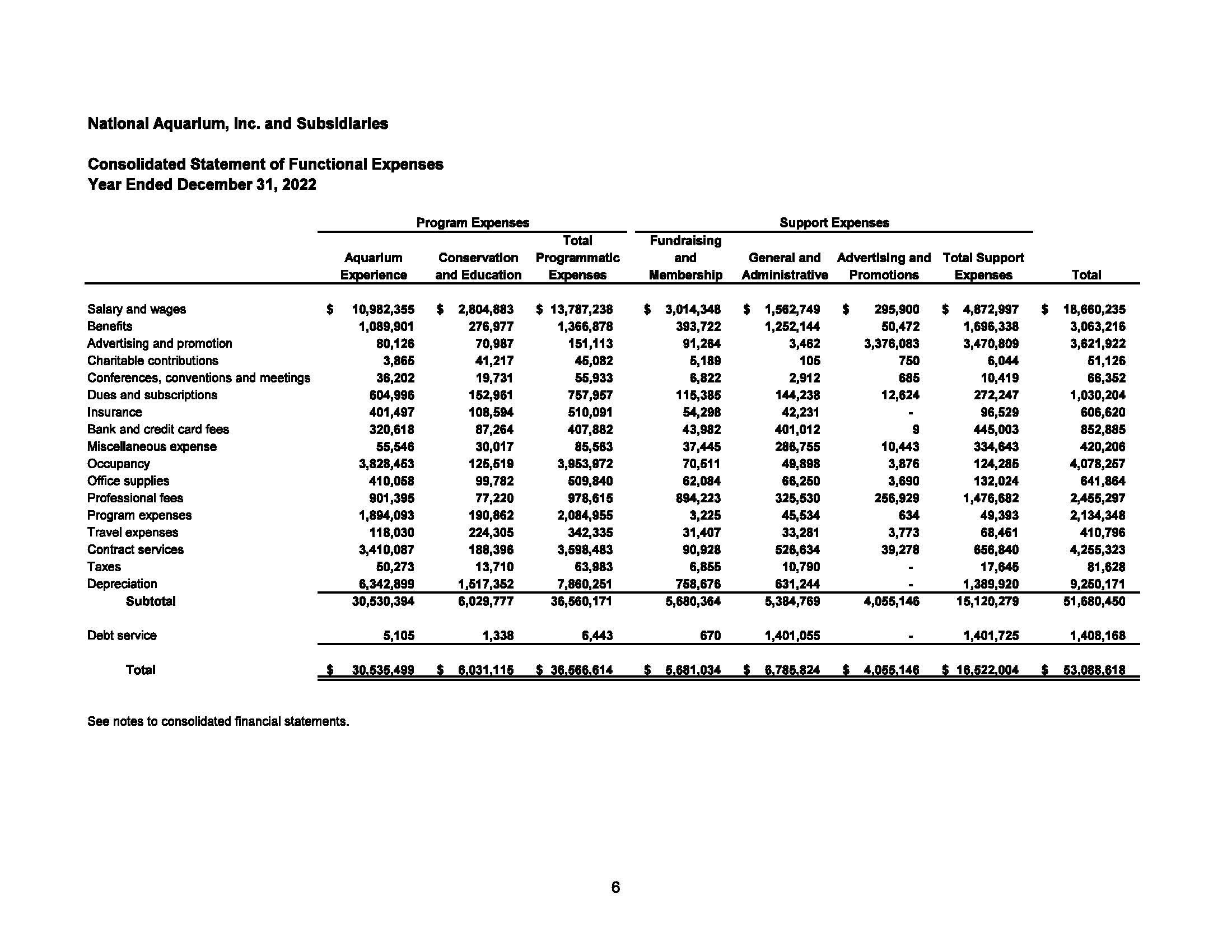
But on the WSP 990, all the programs are combined into one on the expense sheet. This means that travel expenses for education and outreach are combined with travel expenses to Nova Scotia, Ottawa, and Miami for the Canadian Sanctuary and Tokitae projects.
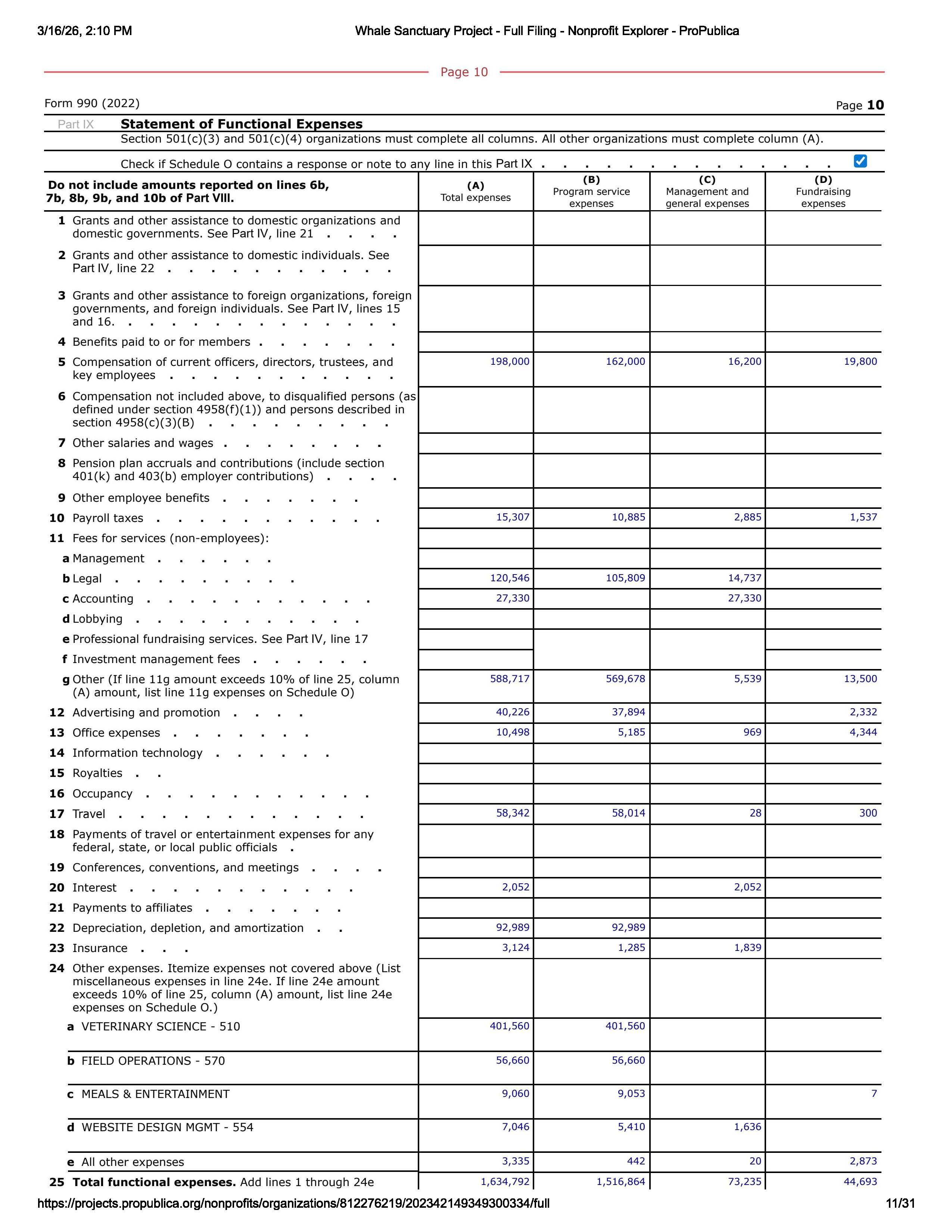
With travel expenses at $58,014, we came to the assumption that $20,000 of that would likely be for education and outreach purposes.
Finally:
WE ALSO CONDUCTED WEBINARS WITH WHALE EXPERTS, PHILOSOPHERS, ARTISTS AND EDUCATORS ON TOPICS THAT EXPLORED HOW, LIKE US HUMANS, CETACEANS ARE SELF-AWARE BEINGS WHO SHARE STRONG EMOTIONAL AND SOCIAL BONDS AND LIVE ACCORDING TO CULTURAL TRADITIONS.
We estimate that professional versions of Zoom and Microsoft Office (for PowerPoint) with multiple use licenses would be at most $500 each. If a laptop was purchased for the intention of the webinars, it likely would be around $2,000, the cost of a high end Macbook in 2022, which gives a total of $3,000 for the year.
The verdict
Here’s our estimated education and outreach total for 2022:
| Student art show | $6,000 |
| Curriculum | $5,000 |
| Travel | $20,000 |
| Webinars | $3,000 |
| TOTAL | $34,000 |
That leaves $75,567 unaccounted for. But more likely than not, we were $3,567 off on our estimate.
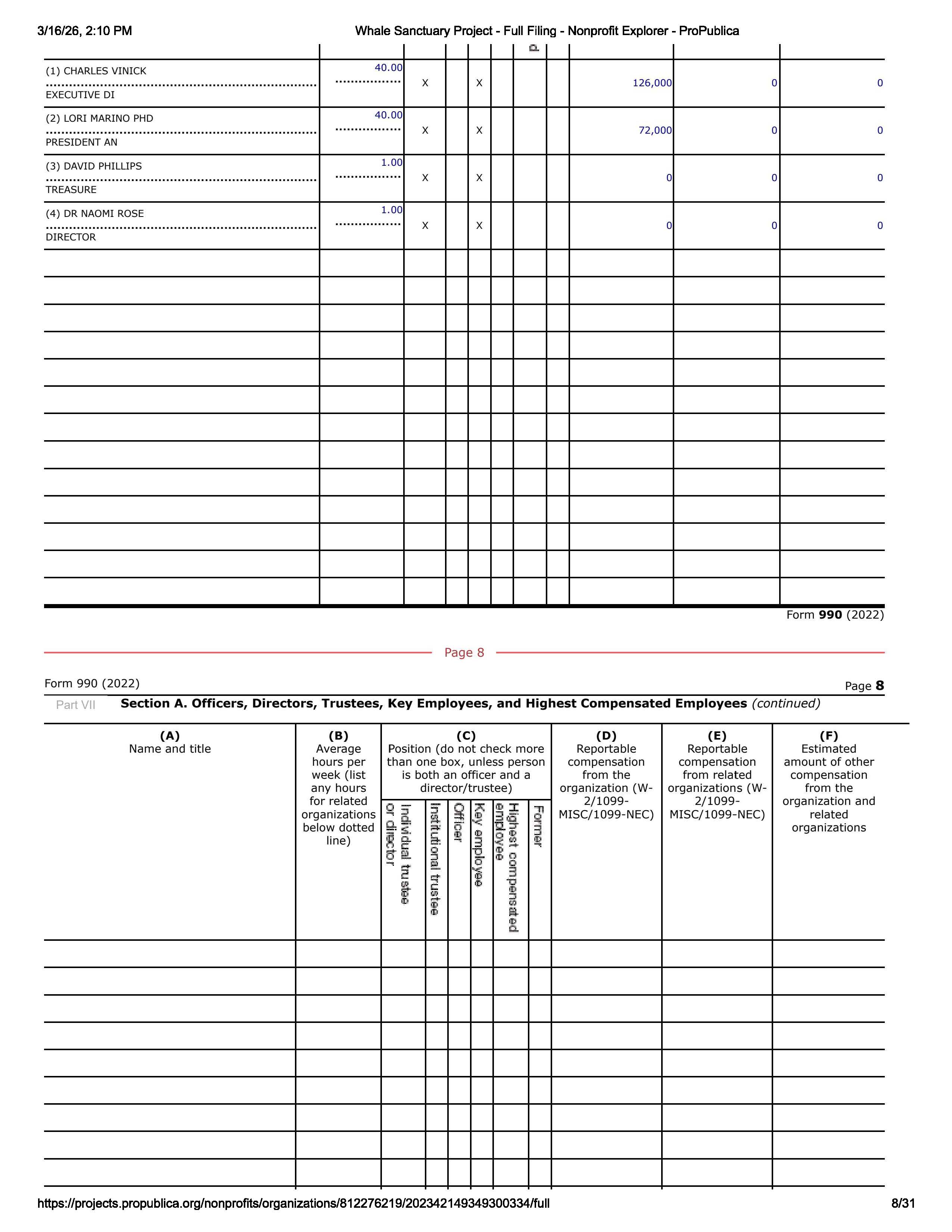
And why did we out Whale Sanctuary Project President and founder Lori Marino in the title?
Because she’s the one who signs the tax returns.
On the 2023 and 2024 returns, which can be downloaded from ProPublica, you’ll find program descriptions listed under the wrong program expenses and amounts thrown in from prior years. Best of luck with your fishing!
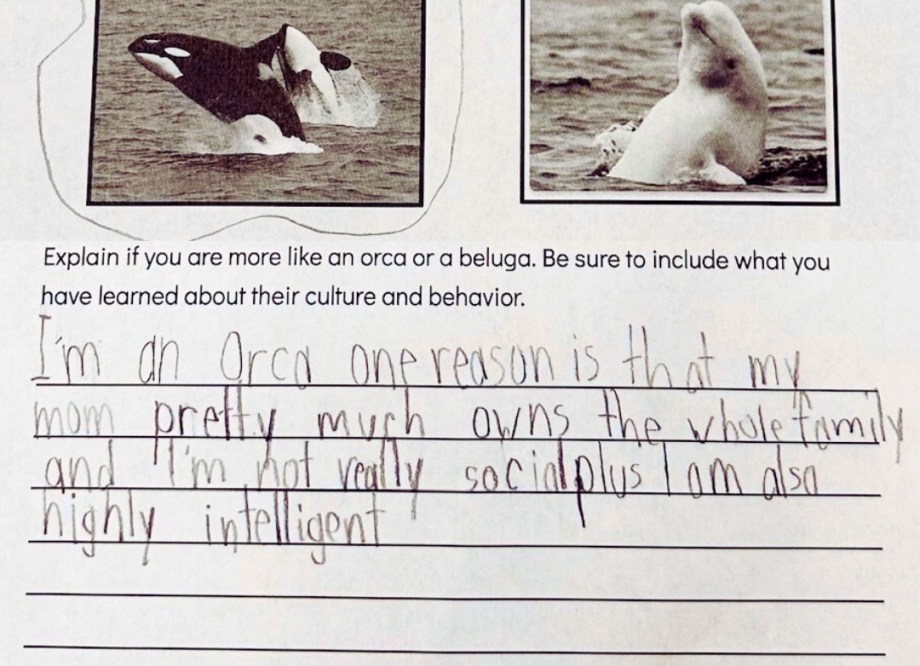
TOP IMAGE: From the WSP student curriculum, posted on Facebook by Whale Sanctuary Project

