

After all, that orca in Miami wasn’t named after Lolita Davidovich.
Here’s an update on whale and dolphin exhibition laws outside the United States.
CANADA
Over the past few weeks, I binge watched the HBO series Succession, all leading up to last weekend’s spectacular season 3 finale. After staying up late to catch the episode, I found myself having a very weird Succession dream. The show, at its essence, is all about a Rupert Murdoch-type family whose members continually backstab each other. The youngest son, Roman, brilliantly played by Kieran Culkin, easily flips sides on a dime depending on what he can get for himself and who he can please in the moment.
In my dream, Roman had been fired from the family’s multinational company and, to spite his father, he became a labor activist protesting the employment practices at the company’s scandal-ridden cruise division. The company sued him for violating a bunch of NDAs, non-competitive clauses, stuff like that. Then at the end of the episode that was unraveling in my head, I discovered that all this time, Roman’s father had been paying him from a secret slush fund to spy on and discredit the other labor activists.
It was an interesting scenario and very true to the narrative of the show. While I can’t think of any instances where something like this happened in real life, and I’m not alluding that it has (after all, it was just a dream), there’s nothing to say a scenario like this couldn’t pan out in the real world.
When companies are confronted with developments that could negatively impact their share value or reputation, they do what they can to control the optics of the situation. Often, that means deflection. One example of deflection happened fairly recently when a theme park chain made five major ride announcements within the week following the sudden death of one of its animals.
Then there’s what happened this past weekend in Niagara Falls, Canada.
On Friday, December 10, Charles Vinick, Executive Director of the Whale Sanctuary Project, met with Andrew Burns, Marineland of Canada’s attorney. Vinick formally requested that the park offer its orca and eight belugas for relocation to its sanctuary, planned for construction near Port Hilford, Nova Scotia.
Also on December 10, the group Last Chance for Animals issued a press release announcing that following the organization’s complaint, the Niagara Police were investigating Marineland for violating S-203, which amended the Canadian Criminal Code with regards to the housing, breeding and performance of cetaceans. The story was picked up by national media outlets, including the CBC.
On Saturday, December 11, the Toronto Star profiled Marineland’s lone orca, Kiska, in a front page exposé highly critical of the park and Burns.
THEN the following all took place on Monday, December 13.
At 11:02 am, the Niagara Police released the following statement:
In October of 2021, 2 District (Niagara Falls) detectives commenced an investigation into allegations of the use of captive cetacean at a Niagara Falls theme park (Marineland).
During the investigation, it was found that dolphins and whales were utilized for entertainment purposes during the month of August, without being authorized to do so following an amendment to the Criminal Code under Bill S-203 on June 21, 2019.
On Monday December 13, 2021, detectives issued the following charge to the corporation of Marineland:
– Use captive cetacean for performance for entertainment purposes without authorization pursuant to a licence contrary to 445.2(4) of the Criminal Code.
Marineland will appear at the Robert S.K. Welch Courthouse on February 14, 2022 to answer to the charges.
At 12:19 pm, Marineland’s marketing department released the following press release via Canada Newswire (CNW):
NIAGARA FALLS, ON, Dec. 13, 2021 /CNW/ – Marineland of Canada Inc.’s educational presentation was designed by experts to provide Canadians with an accessible opportunity to learn about marine life.
Our animal presentation contains marine mammals undertaking behaviours they exhibit in ocean environments. These behaviours are combined with an educational script delivered by Marineland staff, providing a foundation in understanding of these important marine species.
Marineland understands why ideologically driven activists would file a police complaint, and appreciates the pressure the Niagara Regional Police were put under to lay such a charge. We look forward to the opportunity to defend ourselves in a court of law where the feelings of non-experts are not treated as facts and the truth prevails.
We have anticipated since the passage of S-203 in 2019 that activists would seek to abuse the Criminal Code in this manner and are confident in the lawfulness of our programming.
Marineland notes that this is not the first time an organization has applied unreasonable political pressure to use policing powers against Marineland.
We regret that the Niagara Regional Police have found themselves in this position, and anticipate, as happened the last time activists successfully exerted pressure in this way, the courts will find Marineland to be not guilty, as a matter of law.
Marineland continues to be committed to our mission of research, education and conservation and will continue to provide world class care for the animals who call Marineland home.
On Tuesday, December 14, Michael MacDonald, Halifax-based Atlantic region editor for The Canadian Press (Canada’s version of the Associated Press), dropped an article disclosing a Marineland-authored report critical of the Whale Sanctuary Project’s selected location. The article lists contaminants from gold mining runoff and toxic sea life among the issues listed in the report. Within 24 hours, MacDonald’s article had been posted online by the majority of Canada’s newspapers and news channels.
And here’s where controlling optics comes into play: the report was mentioned in the article, but the report itself has not been publicly released by Marineland or Burns, so the general public has only had a hint of what it entails. Without the source material and the context to review, the takeaway for the uninformed and unbiased reader is that Marineland cares about its animals and the Whale Sanctuary Project not so much. In a single move, Marineland deflected attention away from the S-203 charges AND gave the proverbial finger to the Whale Sanctuary Project’s request from four days earlier.
I spoke with someone who, in their line of work, had a responsibility to read the report. Normally, when I use anonymous sources, I advise (see the page disclaimer) that their statements should be considered speculative. Not this time. I’m waiving that disclaimer in this case.
It’s my understanding that this is not an environmental report at all, but something more akin to a white paper, except for two key factors. First, white papers usually curtail at around 2500 words, while this report is a whopping 14,000 words over 72 pages. White papers also give solutions to issues. This one has no solution other than to allude “the only solution is not to give our whales to the Whale Sanctuary Project.” In fact, the report reads more like a legal brief and, from what I understand, even though there was a single site visit by Marineland, no soil or water samples appear to have been taken and examined from the site and most of the toxicology studies included in the report appear to have been taken from internet searches. The report is attributed to Marineland, but lists no human authors.
Now, just in case you think I’m making this up about talking to someone who has read the report, the person I spoke with shared three editing issues that only someone with the report in hand could see. So for the benefit of Marineland and its attorneys:
Page 2, 1st paragraph: “2020” should read “2021.”
Page 3: “Further” in the subheading should be capitalized.
There are 48 instances of the phrase “sanctuary site” throughout the document. They alternate between “Sanctuary Site,” “Sanctuary site,” and “sanctuary site” without any consistency or apparent rules of usage.
I am available should you need an editor or proofreader for your next critique. Mistakes like this are embarrassing, especially if they’ve been made, as I suspect, by legal staff.
Speaking of legal things, Marineland and Burns continue their lawsuit against former trainer turned activist Phil Demers, with trial scheduled for October 2022. In an article published Dec 15 in the online journal LADbible, Demers, a long-term advocate for Marineland’s animals, stated: “I want to see Kiska taken to an interim facility with other orcas until the Whale Sanctuary Project (in Nova Scotia) is built. Visitors can support the Whale Sanctuary as well as support animal abuse whistleblowers at The Whale Sanctuary Project.”
Also on December 15, the Whale Sanctuary Project held a video Q&A titled “Ask Us Anything,” wherein they addressed the allegations by Marineland, among other topics. The following day, Demers held a fireside chat with his followers, encouraging them to continue funding Whale Sanctuary Project, as shown in this video sent by a ThemedReality follower from North Carolina. The original video is by Phil Demers and I am using the footage under fair use doctrine. I have edited the video to focus on his discussion on Whale Sanctuary Project’s finances and because nobody should have to hear Demers ramble on for two minutes about boat prices.
Now onto the other big news:
RUSSIA AND CHINA
On December 15, the Russian Duma passed bill No. 1173188-7, which added a ban on the commercial and coastal capture of cetaceans, with 407 members approving and 1 abstention. Now don’t get too excited, because an amendment which would have banned the capture of cetaceans for “educational” and “cultural” purposes was not approved.
Now what happens if the end product is educational, but the capture is handled by a commercial enterprise, such as White Whale? Would the prohibition be in effect if that were the case? To find out, I asked a friend of mine who had been a corporate attorney in Russia before moving to the US five years ago, where he opened a French café with his wife, where they make the most remarkable blintzes. “You can argue that in court,” he told me, “But there’s a 99% chance you’d lose your case. You have to look at it like this: What are you dropping off at the dock? Is it a commercial dolphin? Do you just leave it at the dock? Then you’re a commercial fisherman and you broke the law. Or is it an education dolphin? Is it captured to be an education dolphin and handed over to the dolphinarium as an education dolphin? Then you’re still within the law.”
One of the biggest problems in defining “education” with regards to cetaceans is that in Russia and China, Russia’s biggest customer for wild caught beluga and orcas, there has been a rapidly expanding trend to use the labels “education” and “conservation” where animal exhibition is involved, including venues where education and conservation are nonexistent. In China, education and conservation are legal requirements. But in most countries where educational content is required by law, there are often no parameters as to what that educational content must entail. Therefore, in many countries, if an audience is taught that dolphins eat fish, that could constitute the entire educational element of a show.
A separate bill, No. 40333-8, was introduced to the Duma on Dec 16 with the intent of adding that “educational” and “cultural” provision into the code. Meanwhile, in China, three things hit all at once. First, the COVID-19 pandemic brought international attention to China’s wet market industry and its illicit animal trade. Then, there were the mass bankruptcies of multi-billion dollar Chinese companies like Evergrande, which caused the government to ramp up its anti-corruption initiatives. Finally, the “whale jail” at the former TINRO research facility made news in China, prompting questions about acquisition and import. The Chinese government has requested that facilities with orcas, belugas, dolphins and pinnipeds imported from Russia get their paperwork in order as it appears quite a few of them were captured and imported in violation of Russian, Chinese, and international statutes.
Do not expect Chinese facilities to get any more orcas through Russia for a number of years. That leaves the current count at 15 – nine in Zhuhai, four in Shanghai, and two in Wuxi. China Cetacean Alliance posted on social media a rumor about a calf being born in Shanghai, but neither I nor my associates in China have been able to confirm this through Chinese social media channels or on visits to and discussions with the park itself.
There is plenty of genetic material frozen on premises at the orca facilities in China from male orcas at parks and aquariums in Japan, Europe, and the Western Hemisphere. This falls under the Chinese definition of “conservation,” which is all about propagating species, and the reason why the orcas aren’t officially kept in show tanks or holding tanks, but rather “breeding facilities.”
FRANCE
One place they won’t be breeding cetaceans any time soon is France, where a new animal rights bill was voted into law with the provision to extinguish the public display of whales of dolphins within five years. Some zoo supporters claimed bribery by animal rights groups was involved. If it was, it was certainly one of the largest, most widespread bribery/corruption campaigns in French history, based on the voting record alone.
The National Assembly voted in the bill on Tuesday, Nov 16: 123 voters, 4 abstentions, 118 for, 1 against. The bill passed the Senate on Thursday Nov 18: 343 voters, 10 abstentions, 332 for, 1 against. Both liberals and conservatives voted in favor of the new law. With a French presidential election scheduled next year and the possible turnover of the government, I contacted the two far right parties considered to be the biggest competition to Emmanuel Macron’s reelection, Reconquête and Rassemblement national. Both told me the same thing – that neither is interested in overturning the new animal rights law.
One zoo publicly protested adoption of the new law, stating “we find it completely unacceptable that the laws are being established under the pressure of any lobbyist groups, in this case anti-zoo activists, instead of the actual, scientifically proven facts!” That park was Loro Parque, not located in France, but rather in Spain’s Canary Islands, more than 3,000 km (1,860 miles) away from the nearest French park housing cetaceans, Marineland Antibes.
There was no statement from Marineland nor its parent company Parques Reunidos, nor was there one from Looping Group or its zoo Planète Sauvage. The reason is quite simple, and while I have seen posts within zoo chat rooms implying that the new law makes an exception to the prohibition if research is conducted at the park or if shows are educational rather than theatrical, points certainly open to interpretation, such arguments are now irrelevant.
Both Parques Reunidos and Looping Group have developed exit plans which call for the relocation of their cetaceans and a redesign of their cetacean facilities for other purposes. The third cetacean park in France, Parc Astérix, has already closed its dolphin facility and relocated the animals to other European countries. In October 2021, Éric Pauget, the Republican delegate to the National Assembly representing the area that includes Antibes, spoke out against the new bill for its expected negative impact on the local economy, and began seeking government financing to help transition the park to its next phase of existence. (As a side note, he has also spoken against Marineland Antibe’s animals being relocated to China, but acknowledged that the decision is not a national one, but rather a corporate one.)
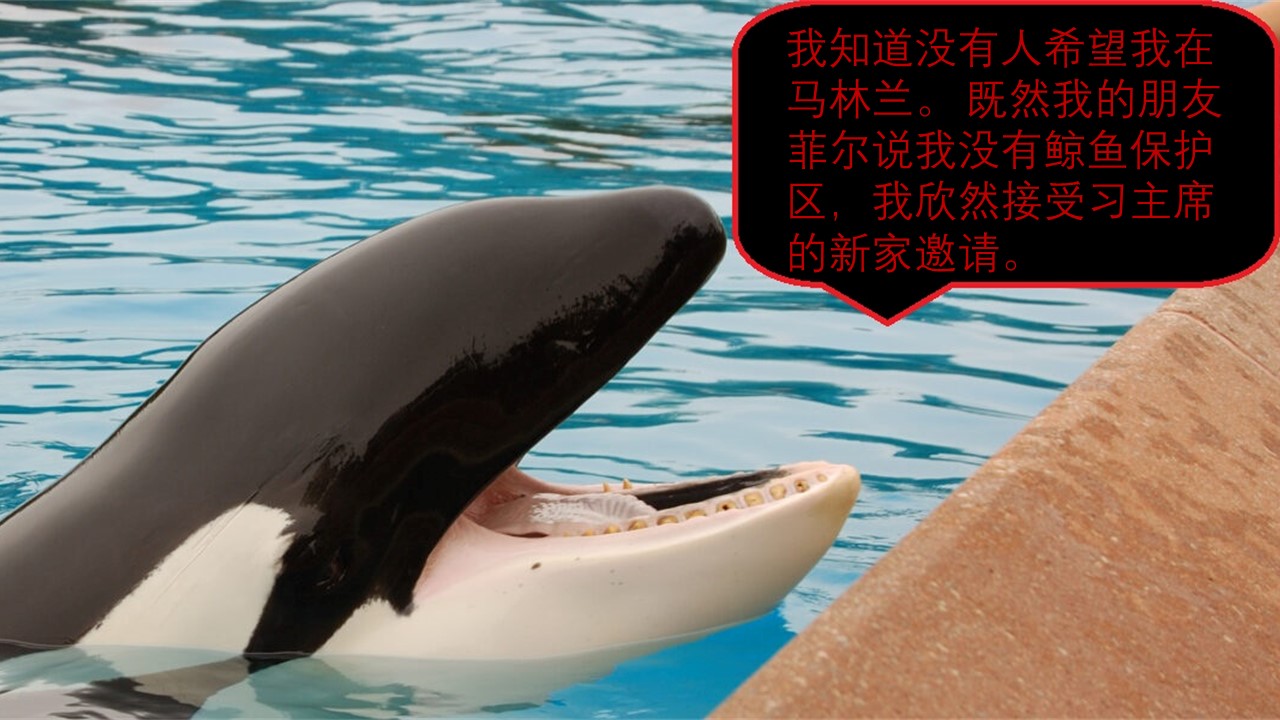
Suffice to say, fighting the new French law is a futile effort. The parks have accepted the future and the future is no cetaceans in parks by 2027.

