
Orca Network, the orca monitoring group in Washington State, regularly organizes trips to the San Ignacio birthing lagoon in Mexico to view gray whales. According to the organization’s website: “At Laguna San Ignacio, our boats offer an intimate encounter like no other. Experience the incredible closeness as mother Gray Whales gracefully approach, inviting us to scratch, pet, and even sing to them.”
It should be noted that they do practice an ethical program, not approaching the whales, but rather allowing the whales to approach them. It didn’t always used to be that way in the birthing lagoons. Decades ago, before Orca Network or its sister organization, the Center for Whale Research, existed, before the passing of the Marine Mammal Protection Act and the Endangered Species Act in the United States, and before the Convention on International Trade in Endangered Species of Wild Fauna and Flora (CITES), a nursing gray whale calf was taken from the lagoons and moved to a theme park.
Back to 1965. killer whales were never part of the original plans for Sea World. But performing gray whales were. Sea World entered into a partnership with the prestigious Scripps Institution of Oceanography at the University of California, San Diego to acquire a gray from the wild. Sea World would train it while researchers from Scripps and elsewhere would take the opportunity to find out as much as they could scientifically about the animal in a confined environment.
Ten months before the arrival of Shamu, in February 1965, a gray whale calf was harpooned off the coast of Baja California, in Scammon’s Lagoon, one of the five Mexican lagoons where the cows give birth and rear their young. The calf was carried to San Diego and placed in a tank at Scripps, where it died two months later from an infection. Based on its looks, it was named Gravel Girtie, or GG for short. This eventually became Gigi. The name was also a play on a rather homely looking woman who lived in a gravel pit in the Dick Tracy comics.
By the end of 1970, visitors to Miami, Galveston, and even Kamogawa, Japan could all experience performing killer whales. Sea World had lost its exclusivity and it was time to move on to the next big thing. That would involve backtracking to the 1965 attempt to capture a gray whale.
In March 1971, a newborn female gray whale calf, named GiGi II, was captured in Scammon’s Lagoon, arriving at Sea World in San Diego on March 17, 1971, where she was placed in the newly constructed Shamu Stadium. There was justification for capturing a newborn. As Ken Norris and Roger Gentry wrote in a paper outlining their capture and tracking harness tests of the time: “We attempted to capture suckling animals only because of the obvious dangers and seamanship problems presented by adult whales.”
Extensive research was conducted on Gigi’s biological processes by leading scientists of the day. To prepare for the studies, GiGi was trained to swim to different parts of the tank, to stay still in place, and to eat upon command. As far as Sea World co-founder and President George Millay was concerned, if she could be trained for research, she could be trained for performance.
As much as Millay wanted a performing baleen whale, which was something no other park could offer, it became cost prohibitive. Gigi was only a year old when she left the park and had she remained, she would have only continued to have grown in size.
At the time, Millay could not afford a tank to house a full grown gray whale. He had just opened a new Shamu Stadium in 1971. He had just opened a new Sea World park in Ohio in 1970 and was in the development phase for a third park for Orlando, with a scheduled opening in 1973. Sea World had also just partnered with the Irvine Company for a new theme park, Magic Mountain, which opened in 1971 just eighteen miles north of Busch Gardens Los Angeles.
Millay was also trying to come to grasps with the fact that a one year old whale was eating $200 dollars worth of food each day, equivalent to over $1,000 today with inflation factored in. As a growing juvenile, that $200 per day would undoubtedly increase exponentially year after year.
But something else was looming on the horizon. In late 1971, Congressman Glenn Anderson of California introduced HR 10420. On October 1, 1972, it was signed into law by President Richard Nixon as the Marine Mammal Protection Act. Sea World had concerns that it would be prohibited from capturing further gray whales under the new law.
So Millay gave up on the grays, doubling down on killer whales.
Today, the modern version of the company, United Parks & Resorts, speaks often about another gray whale, JJ, who was rescued, rehabilitated in public view, and released in 1997, but only rarely about either of the GiGis. When it does, it sticks to the scientific research, not the research of determining if a gray whale could be trained to perform behaviors. George Millay proudly told people about his attempt to train a gray whale. But today’s SeaWorld is not the Sea World of George Millay.
“It is the obvious which is so difficult to see most of the time. People say ‘It’s as plain as the nose on your face.’ But how much of the nose on your face can you see, unless someone holds a mirror up to you?”
– Isaac Asimov
Today, there is a new kind of SeaWorld. It is known as the Whale Sanctuary Project (WSP). When examining its mission, goals, and business practices, it appears by all accounts to be a spectacular failure. But you wouldn’t know that based on its publicity, for if you judged its success solely based on the information it disseminates, you’d think it was the epitome of success.
WSP’s management likes to group it in with two other sanctuary programs, that of the National Aquarium and of SEA LIFE Trust, which is a program run by British theme park operator Merlin Entertainments. For this series, I won’t be equating the other two programs with WSP, because they already own and are in possession of their cetaceans, while WSP has none. When it did have an endangered orca in its possession, through a convoluted business arrangement with Sea Shepherd Conservation Society Chairman Pritam Singh, the whale died in their care in a dilapidated pool (a similar strategy to the current one they have proposed for the two orcas in France – keeping them in their current pool complex, which is structurally compromised, until the frigid winter ends in Nova Scotia at the proposed sanctuary site).
In this series, I will discuss the President and Executive Director of WSP, some of the statements they have made, and how those statements conflict with the reality of the situation. We will look at WSP’s predecessor, the Free Willy Foundation, and recent projects like the Whale Jail, the Nova Scotia sanctuary site, negotiations with MarineLand of Canada, the Miami Seaquarium incident, and we’ll look at the Church.
The Church?
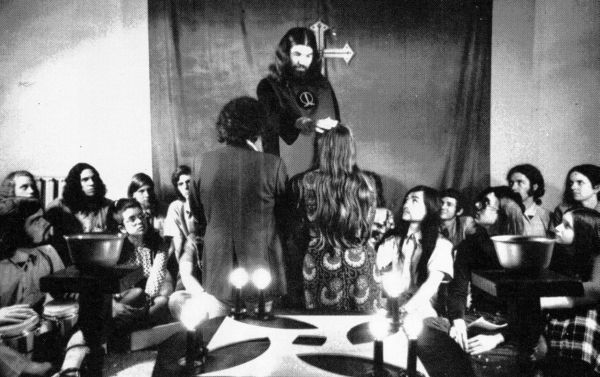
There’s a man who was once known as Hugh. He was a leader of a Satan-worshiping apocalyptic church. As the church kept evolving its beliefs and its missions to better correlate with mainstream Christianity (though remaining true in belief to the End of Days being upon us), Hugh dramatically evolved his identity. He changed his name to Michael, after the archangel who, in the book of Revelation, fought Satan and cast him out of heaven in preparation for the coming of Jesus.
Michael Mountain, the WSP’s co-founder, is the architect of its publicity strategy. The strategy involves publicly releasing heavily edited summaries instead of actual documentation. It involves a continually changing series of “facts,” such as the $5 million restricted donation for construction of the sanctuary site, which later became a $5 million donation contingent on matching funds, and, most recently, a $5 million donation for animal care over a ten year period.
The strategy keeps things vague. The job descriptions of the organization’s two highest paid employees, Lori Marino and Charles Vinick, have never been fully disclosed. Employment contracts have never been made public. The public does not know if they receive bonuses above their salaries. WSP and Marino have stated that Vinick participated as a “volunteer board member” of Friends of Toki. But what about his role as Toki project manager? Was he paid for this and was the money funneled through WSP like for the rest of the staff?
WSP is a publicly funded non-profit. If it were a commercial venture, it would be the equivalent of a publicly traded company.
Consider this: Jim Atchison, John Reilly, Joel Manby, Serge Rivera, Mark Swanson.
Since becoming a publicly traded company, we have had access to this information about each of SeaWorld’s CEOs. That’s because SeaWorld (now United Parks) has made public the original and amended employment contracts, severance agreements, and non-competition agreements with each CEO.
But not WSP, which is planning on building a $15-20 million sanctuary, because Mountain doesn’t want that information public. This is far from a transparent nonprofit.
Tomorrow, I’ll give some background on the Church and how it reinvented itself as an animal sanctuary. But I won’t be going into a lot of detail. Instead, I’ll be concentrating on some of the things that Mountain said about the Church, where he attempted to drastically redefine it – his version of “we caught the whale for research, not entertainment.”
What Mountain had to say isn’t just an attempt to redefine the Church. It lays the groundwork for the WSP’s public relations campaign, a narrative redefining failure as success.
IMAGE: A Processan minister inducts two acolytes into the Church, at which time they become initiates of the Covenant of Christ and Satan. SOURCE: Wheaton College

