
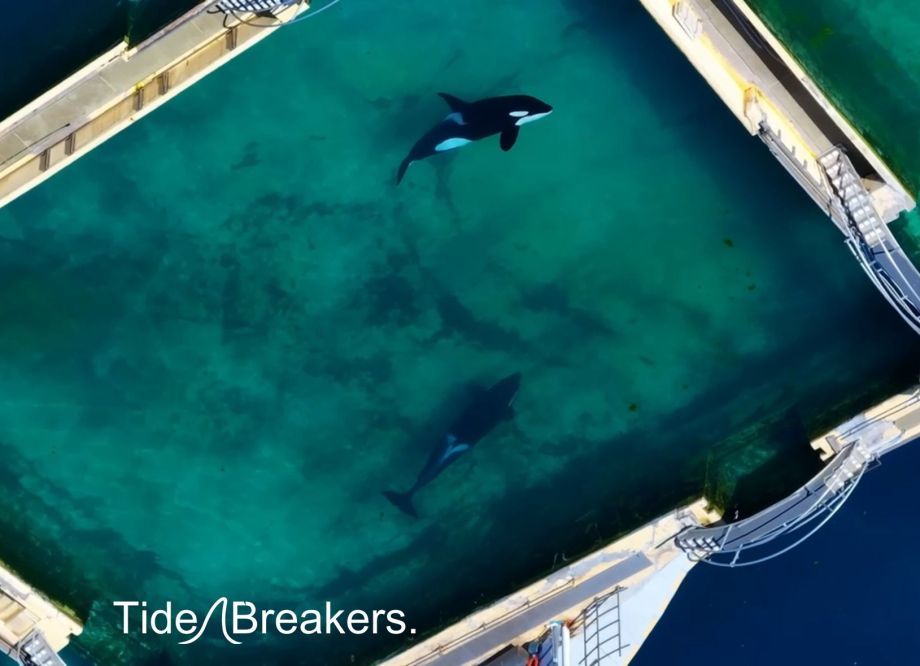
Presented in conjunction with TideBreakers.org
Are the whales abandoned?
There is an argument coming directly from the trainers that because they remain to care for the whales and dolphins, these cetaceans are not abandoned.
While we certainly appreciate all the hard effort the staff has undertaken, we also have to be realistic.
Marineland, owned by Spanish theme park operator Parques Reunidos, is abandoned. The purpose of a theme park or a zoo is to provide activities for the public to do and animals for the public to view. The gates are locked. The public no longer roams the grounds of the park. The park is bleeding money for its owners. The owners who have to pay the staff. The owners who have to pay to keep the animals alive in a park where nobody is paying to view them, or buying lunch, or stuffed orcas, to give money to the owners to pay the staff, just like the good old days. The owners who lose money every day they can’t demolish the animal habitats and build something else.
The whales and dolphins are abandoned. They were abandoned by a company that closed a park without finalizing export permits. They were abandoned by an industry that blames activists for blocking moves. They were abandoned by activists who blame the industry for holding up sanctuaries. And they were abandoned by a government that has created a mockery of the very animal welfare regulations it passed.
To the caretakers, we know that you are doing what you do out of love for these animals. That’s why you’re a trainer, or a veterinarian, or a fish shucker. You took on this career out of love. But that’s not why you’re still there. You’re still there because the whales have been abandoned. You were supposed to be done with your job around April 15. But your bosses in Madrid can’t get these cetaceans out of France. And your bosses won’t talk to the NGOs offering a sanctuary option (in all honesty, these NGOs have a history of portraying your bosses in a bad light, so we get it). And your bosses don’t want to leave the animals to die or to euthanize them because that would look bad and a dead whale isn’t worth anything to a marine life park operator. And your bosses have been ordered by the government to keep the animals alive until a solution is reached. And that’s why you’re there. You’re not there out of love or because you care. That’s why you do what you do. You are there in the abandoned park with the abandoned whales to perform one task – and only one task:
Keep them alive.
A June 6 report from the French Senate sums up your situation well: you, the caretakers, are described as “the collateral victims of a ban without a solution.”
Is algae good for the whales?
We often hear claims that since algae is an indicator of a healthy ocean, it must also be an indicator of a healthy tank. This does not explain algal blooms in swimming pools. When curated and maintained, algae is beneficial. But an ocean environment has things that a tank doesn’t – size, tide, waves – a natural method for flushing out excess. As we have recently seen with the Miami Seaquarium and Gulf World Marine Park, both in Florida, algae overgrowth not only can be a health hazard, but also a safety issue.
Just four years ago, Ingrid Visser wrote the following about the orca facilities in Antibes:
“The facilities at Marineland Antibes are in disrepair, of poor quality and clearly showing neglect. This shows in aspects such a peeling or missing paint, rust stains, cracks in the structures (particularly the orca tanks) and the poor water quality. When I visited Marineland Antibes in June 2016, I noted the poor water quality at the facility. I provide some examples from 2016 as they are appropriate for comparing to the current situation, which has not improved since my visit. At the time of my visit the water was so ‘cloudy’ it was not possible to see the bottom of any of the orca tanks. The water was full of particulates of algae, as well as particulates of unidentified origin, but likely orca faeces, dead fish and other detritus giving it an aqua-marine colouring. Also, I noted a significant amount of algae growing on the tank walls, on tank bottom and floating at the surface. The algae floating at the surface also became a reservoir for floating rubbish.
“Of note is that a government inspection of Miami Seaquarium (Florida, USA) on 8 June 2021, found that there was also algae growing in one of the seapens and that ‘The attending veterinarian evaluated samples of the algae floating in Flipper pool and observed several species of parasites – nematodes, arthropods, and other unidentified species.’ A manatee living in that same water system was evaluated and ‘… severe clinical presentation of diffuse nematode larval migrans with a secondary bacterial infection. Skin biopsies showed nematodoiasis. Parasites that were identified include arthropods (mites), copepods, and nematodes.’ The increase in algae was noted as occurring ‘without [the water] being adequately treated to prevent the overgrowth of algae…’ and this lead to health issues for the animals. The findings by the USA Government are highly relevant to the situation at Marineland Antibes because the increased algae observed at this French facility is also indicative of an ongoing and systemic problem with their own filtration system. Clearly the pumps at Marineland Antibes are not appropriately circulating the water and the chemicals in the water are not adequate. Such an excessive growth of algae can only happen if the water is also nutrient-rich; here, the source of such nutrients are the cetacean’s urine and faeces as well the remains of dead fish which are fed to the orca, all of which are not adequately filtered out of the water. Any suggestion that such algae growth is a sign of ‘good water’ (e.g., the plants can grow because of a balanced pH level) is a distortion of the facts. I provide a series of images downloaded the from the publicly available ‘Google Earth Pro’ timeline history section, showing Marineland Antibes in October 2006, September 2014, June 2015, April 2016, April 2018, August 2018, March 2019 and September 2019. Of those seven images none show the facility clear of algae.”
Dr. Visser concluded by stating: “I have visited all the facilities in the world with captive orca on public display and the conditions at Marineland Antibes are what I would consider some of the worst in the world. For example, no other facility has rafts of algae floating at the surface.”
Options
As we’ve been reporting on the Antibes situation, we’ve been reading the hundreds of comments coming in and ideas people have for what to do with Wikie and Keijo. In the remainder of this post, we will address some of these ideas and add others which are viable options.
For the sake of brevity, we are limiting the information that we share on each option. There are plenty of positives and negatives shared from varied points of view that can be found on the internet and we encourage you to further explore if it interests you.
As we go through each option, we ask you to keep the following in mind:
We’ll be looking at a number of possible solutions. Regardless of whether you consider it “captivity” or animals “under human care,” we group all such cetacean facilities together – whether it be a zoo, aquarium, dolphinarium, theme park, research center, or sanctuary.
Each is susceptible to accidents, negligence, or malfeasance – and some to the trifecta.
There is no such thing as a perfect animal facility. There are bad facilities, better facilities, and much better facilities. If a facility comes across as perfect, you can thank its publicist.
We won’t be counting the number of deaths or accidents or citations per facility. If we did that, we would have to reject them all for being inadequate, leaving only one viable solution – euthanasia. As callous as that may sound, euthanasia should always be considered an option should the facility infrastructure or health decline during Wikie and Keijo’s remaining duration in Antibes.
Set them free in the ocean
Both Wikie and Keijo were born at Marineland. A common argument from exhibitors is that captive-bred orcas cannot be set free as they do not have the skills to fend for themselves The problem with this argument is that it’s never been tested. It is not uncommon for terrestrial animals bred in captivity to be returned to the wild or to a refuge, but no attempt that we’re aware of has been undertaken to transition a captive-born orca to a wild environment with the intention of self-sustaining behavior. It has been attempted once with an orca born in Icelandic waters. That project lost its primary funding and released the whale to fend for itself in the open ocean, which lasted two months before he appeared in Norway begging for human attention.
So we pose the question: if a whale born in the wild returned to its habituated behavior learned after capture, would a whale that has known habituation since birth be able to reverse that behavior? Or was the training strategy flawed and is there need to develop a different approach for captive-born whales?
Regardless, Wikie and Keijo may not be ideal candidates, especially if there is a risk of breeding, as Keijo is inbred, the result of a sexual encounter between Wikie and her brother Valentin. So, yes, Valentin was Keijo’s father AND uncle, while Wikie is his mother AND aunt.
Keep them where they are
The current facility’s infrastructure is compromised, something well known within the industry. On October 3, 2015, during record rainfall, a 6 1/2 foot high wave of debris entered the park, and was funneled through a passage between the orca stadium grandstand and the polar bear exhibit. Mind you, this was not just a flash flood of water, this was heavy debris that inundated the park’s tanks, including those housing the orcas. Turtles were picked up by the wave from a lagoon behind the orca tanks. One was found in a parking lot, another inside the filtration room under the orca grandstand. Shortly after, Valentin died in the contaminated tank. Within the past few weeks, scaffolding has been added to the far east end of the grandstand. We’re not certain if this is to keep the roof from collapsing or to prep for demolition of the structure once the whales are moved.
In its current state, the tanks are crumbling and cracked. According to a June 20, 2025 article on TF1, an engineer hired by Parques Reunidos to examine the tanks noted “increasingly significant cracks and fractures
” and that the tanks are “at the end of their life, after twenty-five years of operation
.”
Further, according to the article, the the tanks are unstable due to ground movements, The engineer cited “the shrinkage-swelling of clays which destabilizes the structures.”
The French government has acknowledged that the whales are not healthy. Just a few days ago, the Ministry of Ecological Transition responded to an enquiry from the French National Assembly on why the whales were still in Antibes. Within the response was a single-line explanation on why the export permit to Kobe, Japan was denied. It had nothing to do with welfare in Japan, training techniques, or pool size. It simply stated: “the journey would be too long and incompatible with the animals’ current health.”
In 2014, when Parques Reunidos purchased the Miami Seaquarium, there were six orcas in the company’s possession, including Tokitae in Miami and Shouka in San Diego. Tokitae was sold in 2022 and died seventeen months later. In Antibes, Valentin died in 2015, Moana in October 2023, and Inouk in March 2024, just five months later. Two deaths within five months in the same facility is a red flag. One of those deaths being caused by a piece of metal digested in the tank is a red flag. We are quite fortunate that Wikie and Keijo are still alive just over a year after Inouk’s passing.
Transitional tank
The whales are unhealthy. The easiest way to remedy this situation is to move them into a clean and safe environment, one where the water is properly filtered and waste is removed, one where the walls aren’t crumbling into the tank. If the French government is adamant on moving these orcas to a sanctuary, we recommend it take under consideration either a move to another facility with a contractual agreement that it be temporary and that breeding not be permitted or to a transitional tank.
Keiko, the Free Willy whale, was granted such a tank at the Oregon Coast Aquarium. Tokitae, the orca in Miami, was denied such a tank due to, as the Executive Director of Whale Sanctuary Project stated, “cost.”
Keiko’s tank was expensive and it took a long time to build. That was thirty years ago. Modern architecture and construction techniques can result in a temporary tank at a much lower cost and shorter period of time. But time is of the essence. The longer it takes to greenlight a tank, the longer it takes to reach completion – even more time that the whales are stuck in their current facility. With expedited permitting by the government and underwriting from the architecture, engineering, and construction industries, as a demonstration project, it could be accomplished quickly and fully subsidized.
For sanctuary developers, the temporary tank provides an area for healing, for training the whales in preparation for the sanctuary, and for gradually altering water temperature to that of the sea pen, all in a closed and fully controlled environment.
Sanctuaries
To date there are no orca sanctuaries built and operational. We are surprised that the NGOs proposing such sanctuaries have taken a “liberate captive cetaceans” approach rather than a conservation approach. This has resulted in a strategy that is dependent on securing whales prior to building a facility, rather than the other way around. We strongly encourage NGOs and corporations developing sanctuaries to make the facility the primary focus, and to take a 4R approach, concentrating on four key objectives – captive retirement, wild rescue, rehabilitation, and, if possible, release.
The exhibitors have long bashed sanctuaries as an activist plot, pushing their shortcomings, even though sanctuary technology and staffing are identical to what one finds in a sea pen utilized for swim programs, shows, or military animals. There is no reason why, if they don’t wish to work with the sanctuary NGOs, exhibitors can’t create sanctuaries of their own, or perhaps something along those lines branded as “retirement centers”.
SEA LIFE Beluga Sanctuary
We have seen a few people suggesting this facility in Iceland as it is in the location where Keiko underwent his training. The sanctuary was designed for three belugas acquired when Merlin Entertainments purchased an aquarium in Shanghai. It has been beleaguered with issues, including the death of one of the whales prior to transport, the sinking of a support boat and leakage of fuel at the sanctuary site, and health issues with the whales when placed in the pen, including ulcers. The belugas have spent most of their time in Iceland in a nearby indoor pool. It is possible the sanctuary netting could be modified for orcas, but that would preclude the introduction of the belugas to the space.
Whale Sanctuary Project
Whale Sanctuary Project has been working on an orca sanctuary for almost a decade. Three of the organization’s four board members were management on the Free Willy project to return the orca Keiko to the wild. Although Keiko did swim on his own for two months, he ended up in Norway with, well, pneumonia, seeking out human companionship.
Whale Sanctuary Project also played a key role in a plan to rehabilitate and relocate Tokitae, the orca at the Miami Seaquarium, to Washington state. The administrators of the effort, which included Whale Sanctuary Project’s executive director, kept the whale in a tank that had been condemned by government officials for almost two years, where she died of, well, pneumonia.
The Ministry of Ecological Transition has denied Whale Sanctuary Project’s proposal for its location in Nova Scotia due to water temperatures. As it is located in the Canadian Maritimes, construction on the site or introduction of whales is limited to 2/3 of the year, which is why Whale Sanctuary Project plans to keep Wikie and Keijo in their current Antibes tanks for the time being.
The organization continues to raise funds, though apparently permits have yet to be granted and the sanctuary site is not constructed. It has yet to publicly release sustainable five and ten year budgets, with sustainability being a concern as the Free Willy Foundation relied on a single billionaire for its primary funding, funding that was eventually discontinued. It is also uncertain how government investigations will impact sustained operations of its proposed sanctuary.
Sea Shepherd France
An proposal for an orca sanctuary near Brest, France, was turned down by the government due to its proximity to military installations. As the group searches for a new location, plans call for Wikie and Keijo to remain in the Antibes tanks, with Sea Shepherd France offering up to 5 million Euro to maintain the facility and pay for the staff. It is unknown how the need to allocate resources to Sea Shepherd France’s other projects will impact its ability to concentrate on establishment and operation of a sanctuary.
San Paolo Island
A partnership between Ric O’Barry’s Dolphin Project and Italian NGOs, this small island sanctuary for dolphins off the coast of Italy is too small for orcas.
Lipsi
The Aegean Marine Life Sanctuary on the Greek island of Lipsi is currently awaiting permits from the Greek government. According to the Sea Shepherd France coalition, netting can be completely installed and the sanctuary operational within sixty days of the granting of permits. We contacted management of the Archipelagos Institute of Marine Conservation, developer of the sanctuary, and were told that they are concentrating on dolphins at the moment, with no current plans for orcas.
Why don’t they work together?
There are a number of reasons the Sea Shepherd France and Whale Sanctuary Project teams will not work together. Here are just two:
The forced resignation of Paul Watson from Sea Shepherd Conservation Society (SSCS), whose chairman, Pritam Singh, partnered with Whale Sanctuary Project on oversight of an orca in Miami, Florida. SSCS then sued Watson to prevent him from using any of the Sea Shepherd intellectual property he had created.
When Sea Shepherd France partner Ric O’Barry departed Earth Island Institute (EII), under whose umbrella his NGO Dolphin Project had sat, he entered into a contentious fight with EII’s David Phillips over the rights to the Dolphin Project name and associated intellectual property. Phillips is currently one of four board members of Whale Sanctuary Project.
Japan and China
The Minister of Environmental transition has given a number of reasons, including concerns with animal welfare conditions within Japan and China, on why she will not approve exports to these two countries.
Loro Parque
Spain’s CITES authority deemed Loro Parque’s orca tanks to be of inadequate size for housing orcas days before a scheduled move from France. Loro Parque is currently appealing this decision and hoping to acquire Wikie and Keijo post haste. Loro Parque has an extensive breeding program, with the ownership arguing against SeaWorld’s 2017 breeding ban, stating that European law gives animals the right to breed. The cancelled move to Loro Parque would have introduced Wikie and Keijo to the new facility within days of the birth of an orca at the Spanish park.
L’Oceanografic and Barcelona Zoo
When managed by Parques Reunidos, original plans for the cetacean stadium called for two orca to be relocated to Valencia from Antibes. However, this plan was quickly abandoned and replaced with a smaller dolphin facility, not designed for orcas.
A dolphinarium facility run by the Barcelona Zoo, which formerly housed the orca Ulises, has now been repurposed. In 2018, the city established a prohibition on cetacean exhibition.
Moskvarium
The current political divide between France and Russia eliminates this facility as a possibility.
Mundo Marino
A single orca resides in this Argentine dolphinarium. The current facility is already too small for the existing orca, Kshamenk.
Oregon Coast Aquarium
The aquarium once housed the transitional tank for Keiko, the orca of Free Willy fame. After Keiko’s departure to Iceland, the space was repurposed into three distinct aquarium habitats. In order for the Antibes orcas to move to the space, the aquarium would need to first remove the large collection of animals from the space and then reconfigure it for orcas. There is also concern if the aquarium is willing to work with a third party managing orcas again after a contentious relationship with those managing Keiko.
SeaWorld Abu Dhabi
SeaWorld Abu Dhabi, although operated by licensee Miral Group, adheres to SeaWorld’s 2017 mandate that no international SeaWorld parks would house whales, including belugas, pilot whales, and orcas.
SeaWorld Orlando and SeaWorld San Antonio
SeaWorld historically has taken in animals from other facilities either after seizure or request from the owner due to inability to properly care for the animal. Shouka’s 2012 move from Six Flags Discovery Kingdom to SeaWorld San Diego is one such example. In Florida, SeaWorld Orlando began removing rockwork from one of its orca tanks in anticipation of a potential request to take in Tokitae, the orca at the Miami Seaquarium.
The SeaWorld parks maintain a no-breeding policy established in 2017. However, the recent death of Kamea in San Antonio could impact the introduction of new whales at that facility.
Six Flags Discovery Kingdom and SeaWorld San Diego
There are some that argue California’s orca protection bill, signed into law in 2016, prohibits imports of orcas into the state.
California Fish and Game Code 4502.5, which is the set of laws enacted by the bill, allows for facilities to intake orcas in a rescue capacity. It is important to note that the code DOES NOT specify rescued orcas must come from the wild.
Rescued orcas may not be used for entertainment purposes, but can participate in “educational presentations,” as long as the facility housing the orcas is a “Bona fide educational or scientific institution.” The code defines “accreditation by a nationally or internationally recognized zoological or aquarium accreditation organization” as acceptable criteria to be considered a bona fide educational or scientific institution. Both Discovery Cove and SeaWorld San Diego are accredited by the Alliance of Marine Mammal Parks and Aquariums (AMMPA) and certified by American Humane. In addition, Discovery Cove is accredited by ZAA and SeaWorld by AZA.
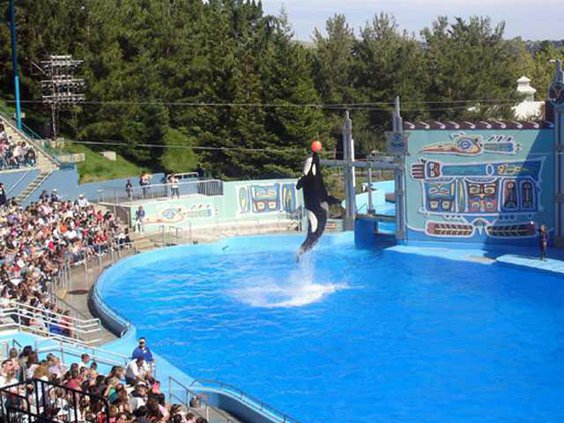
Discovery Kingdom, located near San Francisco, has a largely unused stadium which used to house orcas Vigga and, later, Shouka. It contains four pools, with the show pool 125 feet long and 60 feet wide. If on a temporary basis, intake of the Antibes orcas would be beneficial to the park’s attendance and school visitation, with orcas on view for a limited time, the first time since 2012.
Shouka, the last orca to reside at Discovery Kingdom, is currently at SeaWorld San Diego, but remains under Parques Reunidos ownership. Shouka, born at Marineland Antibes, is Wikie’s older sister. A recent Sea Shepherd France report on why the Antibes orcas should not be sent to Loro Parque states that an ideal sanctuary situation would reintegrate Shouka into her family group. If the move to another facility is a temporary one, why not begin the integration as soon as possible?

