
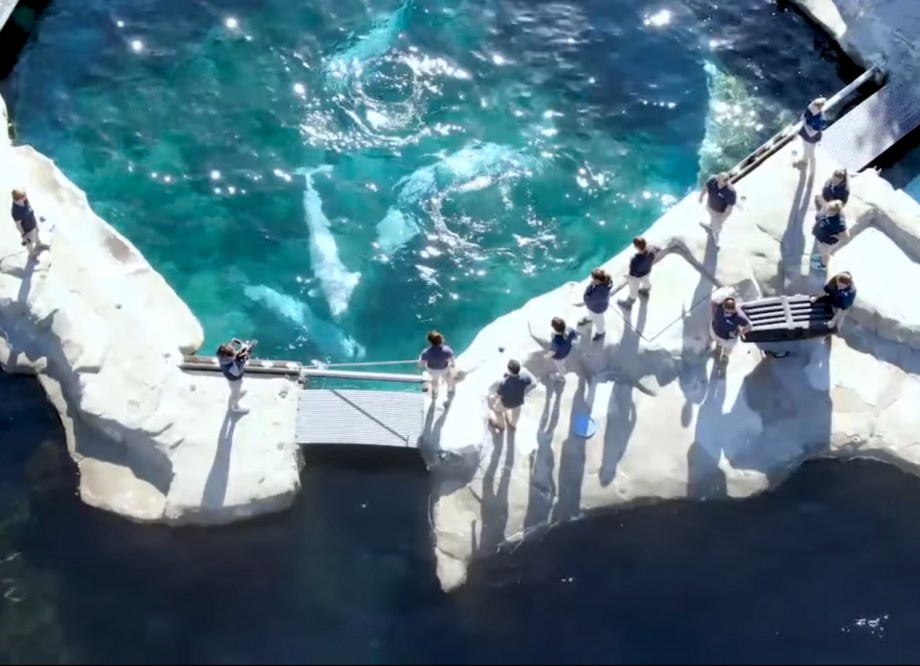
When you look past the acquisition, operational, and veterinary costs, it turns out a beluga’s life is worth only about US$4,000. This is a very easy figure to determine because the United States Department of Agriculture just fined Mystic Aquarium $12,000. That’s $4,000 for each of the three belugas recently acquired under a NOAA research permit from MarineLand Canada that passed away within the past two years at Mystic.
For Dr. Naomi Rose, the Animal Welfare Institute’s (AWI) marine mammal specialist, $4,000 per beluga is actually “better than nothing.” And she’s right, mathematically, of course. Dr. Rose is basing her argument on the fact that the USDA actually instigated any kind of fine at all.
But I want to put this into perspective. That $12,000 fine is just under 300 adult general admission tickets or 150 basic tier memberships sold by Mystic Aquarium. When we look at Mystic’s audited financial report for the last year publicly available, we see that in that year, 2022, Mystic sold $16 million in admissions and $2 million in memberships. $12,000 can easily be made at the gate in a weekend…..or less.
$12,000 is also about US$10K less than the Canadian $30,000 penalty recently assigned to BC documentary filmmakers for filming Northern Resident killer whales by drone without a permit.
Most likely, that $12,000 penalty will be paid by the aquarium’s insurance policy.
What does $12,000 get Mystic in return? The fine is part of a settlement, which states there will be no plea. Mystic’s problems are swept under the rug and no damning documentation becomes evidence in an administrative or enforcement action by USDA – documentation that could become publicly available via Freedom of Information or court document requests.
Mystic and “its officers, owners, employees, volunteers, and contractors” are not held liable for the deaths nor the actions leading up to them..
And that’s why when Dr. Naomi Rose states “it’s better than nothing,” it’s very troubling.
This is an animal welfare expert who fought diligently to prevent the importation of the whales, and to have reproductive research removed from the permit. So why “better than nothing?”
Dr. Rose is an interesting person to read. Sometimes, she’s very vocal. At other times, she stays quiet or states the minimum she can under the circumstances, such as “better than nothing.”
THE LOOPHOLE
On 29 April 2022, Dr. Rose and Georgia Hancock, Senior Attorney and co-Director of the Marine Wildlife Program at AWI, wrote an extensive letter to Joline Harrison and Amy Sloan of NOAA’s Office of Protected Resources, along with a second letter to Elizabeth Goldentyer, the Deputy Administrator of USDA’s Animal Care division. The letters showed concern about what my colleagues and I have named the “Goldentyer Loophole,” wherein Goldentyer issued a license to The Dolphin Company (TDC) for the Miami Seaquarium that did not include the Whale Bowl, which housed Tokitae (AKA Lolita), a Southern Resident Killer Whale listed as endangered under the Endangered Species Act (ESA).
According to Goldentyer’s authorization letter, as long as “the Whale Stadium is inaccessible to the public and the animals contained therein are not visible to the public,” the facility would not fall under USDA oversight. In email correspondence between USDA and TDC recently obtained by myself and my colleagues, USDA officials offered the Goldentyer Loophole option within days of the Whale Bowl failing a 1 February 2022 inspection, noting in the email that this would result in the loss of federal Animal Welfare Act (AWA) protections of the animals residing within. In their letters to the two federal agencies, Rose and Hancock asserted that such an action was setting a dangerous precedent that could easily be applied to other venues.
Followup letters were sent in August, after which the trail of correspondence went dry. It could be that there was further correspondence between Rose and the federal agencies on the matter, but that they have yet to be received by us via FOIA requests.
Or, and this is pure speculation, Rose, who is a board member of the Whale Sanctuary Project, (WSP) may have simply gone silent on the matter as Friends of Toki (FOT), tied in with WSP in multiple ways, including staffing, support, and financial sponsorship (WSP handled FOT’s funds – it’s alluded to in the 2022 tax return and specified in the 2023 filing), was taking on a greater role in the care of Tokitae and was close to an agreement with TDC to move her to a sanctuary in Washington state. Anything that could have a negative impact on the fragile relationship between FOT and TDC, such as fighting for the reversal of the Goldentyer Loophole, might have been dissuaded at that time.
But there’s something else that’s concerning, which also benefits WSP. As it now stands, there is no facility license category under USDA for sanctuaries, which are required to register under an exhibitor license. In July 2022, just three months after Rose and Hancock sent their letters to NOAA and USDA, the Strengthening Welfare in Marine Settings (SWIMS) Act was introduced in Congress. Instead of ordering USDA to develop a license category for sanctuaries, the act expanded upon the Orca Responsibility and Care Advancement (ORCA) Act, introduced in 2015 (and California’s orca law before that), by adding three additional species of cetaceans and six words to the definition of sanctuary. Those six words – “for the purpose of public display” are the equivalent of “”the Whale Stadium is inaccessible to the public and the animals contained therein are not visible to the public.” Much as the Goldentyer Loophole set in motion a precedent for allowing zoos, aquariums, and other animal attractions to have federal protections and oversight removed simply by taking animals off exhibition, these six words set the foundation for the Goldentyer Loophole to be applied to sanctuaries – not just cetacean sanctuaries, but ALL sanctuaries within the United States.
I have not seen any evidence of Dr. Rose protesting the addition of these six words. Of course, she is a board member of WSP and, at the time of the bill’s initial introduction, a sanctuary for Tokitae and other whales was being developed in Washington state by the Lummi Nation, FOT, and WSP. This would have been an important win for WSP and would have circumvented an earlier setback.
In its earlier days, WSP announced that it was developing two sanctuaries – one in the Pacific Northwest, either British Columbia or Washington state, for orcas, and the second in Nova Scotia for belugas. In 2019, the two were combined into a single proposed facility on the Atlantic coast. There has been no definite answer given as to why, such as cost issues or inability to obtain animals in a timely manner, but the switch followed a 2018 joint agency effort to save an emaciated Southern Resident orca, J50, also known as Scarlet.
On 17 September 2018, Lynda W. Mapes reported in the Seattle Times about public hearings that took place to discuss NOAA’s plans to rescue J50. “Attendees criticized NOAA,” she wrote, “for coordinating the now-canceled rescue effort with SeaWorld, the entertainment park that had for decades profited from capturing the animals for use in its aquariums.”

There were concerns among many in the region that SeaWorld was using J50 to improve its reputation post-Blackfish. To others, there were grave concerns about Whale Sanctuary Project being involved in the project with SeaWorld. Rumors began to spread that the proposed Washington state sanctuary site could also be used as a staging ground for sending orcas to SeaWorld. I will note that the rumors, though heartfelt, were unsubstantiated, and that the Lummi Indian Business Council and the Center for Whale Research were also involved in the rescue effort. On 22 September, former SeaWorld trainer and Blackfish star John Hargrove tweeted his resignation from the WSP advisory board. His first tweet, which would culminate in a thread of over twenty tweets, stated “I refuse to be attached to anything SeaWorld is part of.” In response, WSP significantly downplayed his role in advising the organization.
Had Tokitae remained alive and Jim Irsay continued funding, WSP would have had its sanctuary in Washington state. With the potential passage of the SWIMS Act, there was a strong possibility of no oversight over this sanctuary by the USDA, thanks to the inclusion of the Goldentyer Loophole in the Act..
THE MAN WITH THE KEYS
Now, WSP is attempting to gain possession of the two remaining orcas at Marineland, in Antibes, France. In an 11 October 2024 email blast, WSP co-founder Michael Mountain wrote:
“Earlier this year, we were advised that Marineland had told the government that it would follow the government’s recommendations, whatever they might be.
“But it was also public knowledge that Marineland was making plans to send Wikie and Keijo to Kobe Suma SeaWorld, an entertainment park in Japan, where many think they would likely be separated from each other and used for breeding.
“This clearly goes against the entire purpose and spirit of the law. . .”
There are a few things Mountain failed to mention, which is why I’m here.
First, the recently made public June 2024 report by France’s Inspector General of the Environment specifically states that “Marineland and AFdPZ [l’Association Française des Parcs Zoologiques] are opposed to any sanctuary project for reasons of animal welfare (difficulty in controlling the environment), implementation delays, and on principle (considered a victory for the opponents of zoological parks who will feel supported in their campaign).”
And while Marineland may agree to moving the whales to a sanctuary, there is a second factor Mountain failed to mention comes into play – the fact that Marineland will have final say where the animals go – whether that be a sanctuary or another park, such as Kobe Suma Sea World in Japan or Loro Parque in the Canary Islands.
There is, of course, a third option, which would be to keep the whales in their current facility, which could be done under a research permit. However, the facility is structurally damaged, making such a choice both unviable and cost prohibitive.
But Marineland itself is just a park and will not be making the decision. That will come from its parent company, headquartered in Madrid, Spain – Parques Reunidos.
And now the clincher.

One of the key decision makers at Parques Reunidos is both the CEO of its American subsidiary, Palace Entertainment, and Chief Operating Officer of its European parks and attractions, including Marineland – John Reilly.
I interviewed Reilly in 2014 inside the California State Capitol building. I found him to be soft spoken, but very astute and calculating. Here are some things I can tell you that Reilly has not forgotten:
In 2013, he was the Park President of SeaWorld San Diego, when Blackfish was released. He knows very well that WSP Founder and President Lori Marino appeared in the film and supported it in media during its extensive run on CNN.

In 2014, Reilly found himself in Sacramento, dealing with California’s Orca Welfare and Safety Act, a bill that only impacted one facility in the state – his. He knows quite well that Dr. Naomi Rose played a key role in the drafting of that bill and that, just prior to its introduction, she appeared as one of the major characters of David Kirby’s anti-captivity book Death at SeaWorld.

Reilly was promoted from San Diego Park President to Chief Parks Operations Officer, overseeing the company’s entire portfolio of parks, in 2016 and in 2018 to SeaWorld Entertainment’s interim CEO. In all three of these positions, he had to deal with a slew of lawsuits, most regarding claims of false marketing. One of these was Anderson v SeaWorld, which was orchestrated by the International Marine Mammal Project (IMMP) of Earth Island Institute – details are actually explained on their website. Reilly knows that the Executive Director of IMMP happens to be David Phillips, the third WSP board member and its treasurer.
That leaves only one more WSP board member.
Let’s say, for shits and giggles, that Lori Marino’s argument that WSP had nothing to do with running FOT, that the WSP team members that were assisting with Tokitae were doing it on their own volition, and that none were being paid for their work for Tokitae by WSP is all true. Let’s assume this, even though there’s plenty of evidence in WSP’s own documentation to show otherwise.

That would mean that WSP Executive Director Charles Vinick was not overseeing the Tokitae project on behalf of WSP.
But that would be irrelevant to Reilly. All he needs to know, and he does, is that Tokitae died only 17 months after Reilly’s company sold her, and she died under a sanctuary project managed by the same man who wants that company’s two French whales.
Six words were added to the SWIMS Act. I’ll add two words here.
GOOD LUCK.
So why is a $12,000 fine for the death of three beluga whales from an endangered stock “better than nothing?”
I believe that WSP is either currently in talks, or attempting to enter into talks, to obtain the remaining two MarineLand belugas at Mystic for its proposed Nova Scotia sanctuary. I know of two individuals who were consultants for FOT that have strong ties with Mystic, and it’s very probable that these individuals may be introducing the parties to each other, or at least trying. Any harsher criticism from Rose on the settlement could result in Mystic shying away.
Of course, I could be wrong. If I am, that tells me that WSP is in a worse place than I had thought.
THE STINKING ROSE
I like Dr. Rose. I’ve had plenty of great conversations with her. We don’t always agree, but I’ve learned a lot from talking with her.
Funny thing: every time I write or hear Dr. Rose’s name, I think of the flower. It’s kind of inevitable.
My mother raises award-winning roses and every time I visit, she gives me a few cuttings to take back to my lovely wife. I know that my wife will not water them and they will soon die, and I refuse to do so myself because the flowers are now hers. I also know that nothing good will come from me refusing my mother, which is why I take the cuttings, because it’s better than nothing.

There’s another kind of rose, it’s called the “stinking rose” – the garlic plant. In fact, a famous San Francisco restaurant called The Stinking Rose specializes in dishes oversaturated with garlic.
As much as I want to think of Dr. Rose in a pleasant way, the stinking rose has been coming to mind lately, because “better than nothing” coming from the mouth of this Rose sure does stink.
TOP: MarineLand Canada belugas at Mystic Aquarium. Credit: Mystic Aquarium

