
NOTE: Since the whale is referred to as “Lolita” in the emails, the name has been used throughout this post for purposes of conformity.
September 27, 2022: Dr. Tom Reidarson emails FDA requesting permission to import antibiotic Faropenem for “compassionate use” on killer whale Lolita. The drug is only available in China, Japan, and India.
He writes: “We are currently battling an MDR [Multi-Drug Resistant] E. coli and Pseudomonas aeruginosa pulmonary infection where each bacterium is only sensitive to Amikacin and third generation cephalosporins, respectively, and both sensitive to carbopenems.
“We just began using IV Meropenem and would like to be able to switch to the oral carbopenem, Faropenem. Since it is currently not available in the United States my contact in mainland China . . . from a large oceanarium is able to arrange acquisition from a local pharmaceutical company and mailing to the United States.”
September 29, 2022: Reidarson adds additional details.
“Lolita is experiencing severe pneumonia likely from an ESBL E. coli, MDR Pseudomonas aeruginosa, and possible MRSA [Methicillin-resistant Staphylococcus aureus] . . . We plan to only order enough
Faropenem for 30 days . . . Faropenem is only to be administered at 3 mgkg orally three times a day for the 57 year old killer whale named Lolita residing at the Miami Sea Aquarium . . . Following extensive blood and respiratory exudate cultures with sensitivities we have discovered there are no oral antimicrobials that are capable to treating her infections. Over the past 8 months we have used aminoglycosides and third generation injectable cephalosporins with variable results. She is currently on Meropenem, an injectable carbopenem and hope to be able to transition her from Meropenem to Faropenem once we receive the latter.”
October 5, 2022: FDA emails an authorization letter to Reidarson, authorizing import of a less than 90 day supply of Faropenem from Japan.
October 9, 2022: Rediarson emails FDA: “Thank you again for granting us My colleague, Charles Vinick who is purchasing the Faropenem, is having trouble convincing his Japanese contact for Daiichi Sankyo Co., LTD that this truly is a legitimate [request for] Faropenem. I’m sorry to ask, but is it possible to provide us with a permit to import this antibiotic either in a PDF form or some other form that is not an email? We believe the Japanese are having trouble accepting an email and may need a more official appearing document. I apologize for prolonging this process, but it is vital that we acquire this as soon as humanly possible.
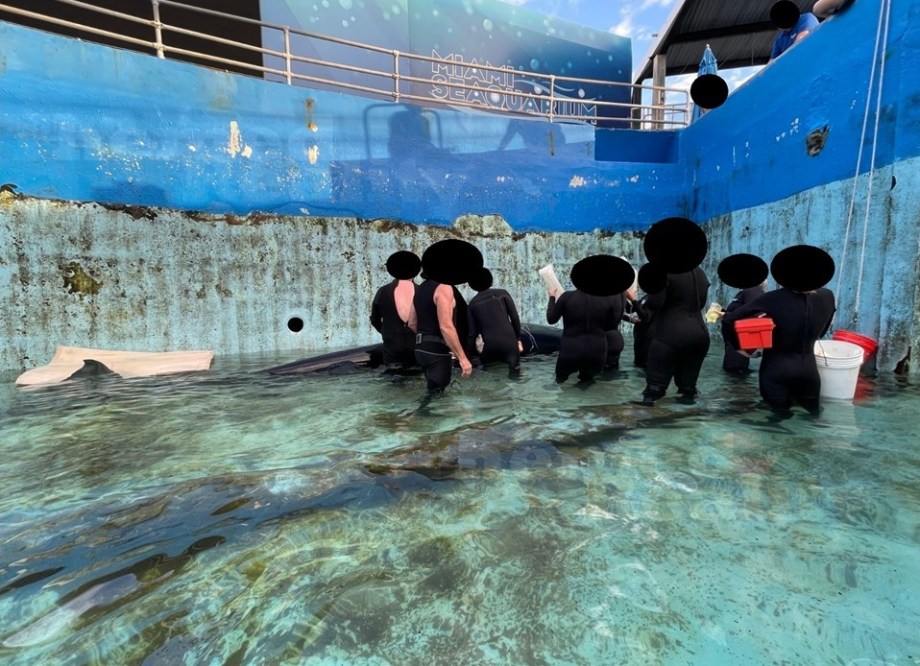
Early October 2022: Friends of Toki (in a December 13, 2022 update) reports: “In early October 2022, Toki experienced another health event appearing more serious than preceding episodes. This time she presented with gastrointestinal signs as well as a complete loss of appetite. This situation made it virtually impossible to adequately provide medical treatments. A rare pool drop was undertaken in order to reestablish therapy. Toki and her training staff managed this situation efficiently with minimal stress. This approach was continued for a week and discontinued when her lab test results began to improve, and her appetite returned.”
November 21, 2022 11:58 am: Reidarson emails FDA: “Thank you again for helping our team navigate through the acquisition of a 30-day supply of Faropenem from the Maruho company in Japan for Lolita, the killer whale from Miami Seaquarium. Once we figured out which Japanese company was producing Faropenem the process became easier after your spot-on instructions. Although it is early to be absolutely certain, we believe Lolita is improving and benefiting from this antibiotic. I have to say that the timing of acquisition could not have been better since we started her on it on the day it arrived in Miami. Well done to you and everyone involved!
“The reason for this email is to begin the process of obtaining permission to purchase more Faropenem from the Maruho Company before the end of December, perhaps as early as December 7, 2022, and then obtain an open ended permit to purchase Faropenem beginning January 2023. My original calculation was to have enough for November 11 through December 10, 2022, but since we do not whether this will provide a cure we want to be certain that we will have enough to get Lolita through at least another month. As you can imagine we need to feel comfortable that her chronic infection is sufficiently controlled to make the eventual decision to withdraw the antibiotic.
“We are taking blood samples at four hour intervals [which former SeaWorld orca trainer Valerie Greene considers a huge red flag] over the first week of therapy in order to understand the pharmacokinetics of Faropenem in an animal that has never been treated with this antibiotic. Based on human treatment and one other smaller marine mammal we chose to give Faropenem every eight hours, however these studies will eventually guide treatment that may may lead his to change the dose or even dosing interval. Of course this would never be possible had we been unable to obtain Faropenem and it was your efforts that provided this opportunity.
November 21, 2022, 5:56 p.m. (six hours later) : Reidarson emails FDA again: “Since we do not want to run short of Faropenem for Lolita I would like to apply for an additional shipment of 500 tablets and 3 boxes of 100 tablets, 200 mg tablets, for a total of 4800 tablets, to be ordered before December 2022. Is there any chance you can grant us an extension that enables us to order the same number of tablets, in increments of 4800, as needed in 2023 without having to request permission each time? If not, I am more than happy to submit a new application for each order.
“We hope that the current order and even some of a second order for 2022 will be sufficient to halt the infection, but we want to be prepared in the event she relapses as she has in the past with other antibiotics. For this reason, we want to always be prepared for the worse case scenario that she gives us very little notice and we need to place her on at a moment’s notice.”
November 23, 2022: Reidarson emails FDA with a follow-up: “Can we proceed with placing an order now so we can obtain another 30 day supply before we run out of Faropenem in 2 weeks?”
December 2, 2022: Reidarson emails FDA with a second follow-up: “I certainly do not disrupt your business, but I was hoping to be able to place the order for 17,000 tablets of Faropenem before this weekend. With the upcoming holidays I am afraid shipping from Japan to the United States may be slower than usual.”
Alone
While Reidarson mentions in one email that he is “one of two caretakers,” in this email chain he never requests permission for the Seaquarium’s staff veterinarian Shelby Loos, on whose Florida license the permit to distribute prescription medication is based, to order in his absence. Nor does he authorize The Dolphin Company’s corporate veterinarian, nor Friends of Toki’s other consulting veterinarians, James MacBain and Stephanie Norman, the latter of which is licensed to practice in Florida. While Reidarson himself is not licensed in the state, he was acting in his capacity as a consulting board certified specialist and it is understood he was taking these actions with the authorization of Loos.
However, one line in the email thread brings up a concern. On October 25, 2022, Charles Vinick emails the FDA requesting a change in the wording on the permit due to a change in packaging from the supplier, in order to prevent delays through customs. He begins the email with: “My colleague, Dr. Thomas Reidarson, is in Curacao this evening with limited email connectivity.”
This brings forth a question: What would happen if supplies were running low and Reidarson could not be reached for an extensive amount of time? Why were the Seaquarium and The Dolphin Company corporate veterinarians not included as agents for requesting additional permits for the medication?
At the time, Reidarson was transitioning from the Miami Seaquarium being his client to being directly contracted by Friends of Toki and solely dealing with Lolita on the nonprofit’s behalf at the park. The esteemed Chair of the Center for Whale Research, Howard Garrett, who introduced the Lummi nation to Whale Sanctuary Project and Charles Vinick, gives one possible explanation. In a September 11, 2023 Facebook post, he writes:
I’m seeing many people casting blame and distrust on Friends of Toki. Yes we are hurt and angry as am I but the fault for Toki’s captivity and her death was the overall marine park industry, not the people trying to rescue her.
Very few among us have a realistic understanding of the power, depth and reach of this industry. With the goal of never allowing any captive whale or dolphin to ever be moved to their natural habitat or any sanctuary, the industry has totally controlled the thinking of virtually everyone involved in captivity issues, not just trainers and employees but all their audiences and all the media and most of the government agencies and much of the scientific community. Even some who oppose captivity still held beliefs that argued against Toki going home, like saying she’s too old or too unhealthy.
Friends of Toki were honest but they were silenced because they did not have the knowledge to debate issues like Toki’s fitness to travel or her memories of her life before capture, or the therapeutic effects of her home waters. Friends of Toki were weak when those questions came up, and they always did. Dolphin Company employees from trainers to security guards ruled the Whale Stadium and they universally opposed Toki ever going home. Eduardo Albor had no real control over his employees. Even if he wanted to tell them to cooperate with FOT they would refuse because they were effectively held captive themselves by the industry cult that was hostile towards anyone wanting to return Toki or any whale or dolphin to the ocean. Eduardo couldn’t fire them because he couldn’t replace them.
FOT didn’t have answers against the onslaught of industry beliefs. That’s why no permits were submitted to NOAA and that’s why Toki’s return home was delayed, plus the fact that funding wasn’t guaranteed until Jim Irsay stepped up in March this year.
Toki was always ready to come home. Please don’t blame anyone involved with Friends of Toki. They were overwhelmed by industry opposition.
Here’s some history to explain the depth of the determination by the marine park industry to never allow a captive whale to return to its ocean home. In 1996 Keiko was moved from Mexico to the Oregon Coast Aquarium for rehabilitation prior to being moved to Iceland. He recovered well and the Free Willy/Keiko Foundation began preparations to move him back to Iceland. In 1997 the management of Oregon Coast Aquarium sabotaged Keiko’s water quality by blocking access to the ozone filter system so that Free Willy Keiko Foundation was not able to change the filters, causing the water to become filthy with feces and Keiko to become ill. Then the aquarium used their vet to very publicly blame the Foundation for Keiko’s illness, causing a public scandal and leading the Foundation to hold a press conference to clear their name and get a court order to change the filters, which they did. That hostility by the aquarium actually expedited Keiko’s move to Iceland but it could also have killed him. The aquarium apparently hoped they could drive the Foundation away and keep the whale and the ticket sales which were through the roof. Or kill him. Either way it would have blocked his return to Iceland. Keiko got away from them but they still have twisted his story to sound like a failure and a reason to never consider returning another whale to their natural home. The Oregon Coast Aquarium is a member of the Alliance of Marine Mammal Parks and Aquariums. The Seaquarium is also a member. It is a cult.
These are some of the circumstances to be considered.
E. Coli
How did Lolita come down with a drug resistant form of E. coli? She had been swimming in a poorly filtered pool, in a park where the outgoing sewage pipe was leaking into Biscayne Bay, one of the most polluted bodies of water in the U.S., with the currents bringing the detritis back towards the park’s water intake pipe. In December, 2023, the USDA documented alarming counts of coliform (a bacteria found in feces) levels at Miami Seaquarium that were so dangerous that humans were advised against entering the water. The fecal situation was so bad in the area that just a week after Lolita’s death, “fecal pollution” was identified at nearby Crandon Park, on the north tip of Key Biscayne. Excessive coliforms can cause kidney damage in marine mammals.
Based on documents supplied by Friends of Toki, the new filtration system at the Whale Bowl was targeted for completion by December 2022, but was not fully operational until April 2023, only four months before Lolita’s death.
Renal failure
Another item of concern regards Lolita’s kidneys. In studies conducted with humans and dogs, renal damage has been documented as a side effect of Faropenem. Physicians are advised to use moderation with administering the drug when renal compromise is evident.
In an internal Seaquarium text message released via FOIA by NOAA, Reidarson states on December 29, 2021, approximately ten months before the request for Faropenem: “For Toki [aka Lolita] our gola is to get her back to 130 for hydration only but not to go higher (and we don’t think it’s necessary at the moment). Once she is off dex we will continue to assess her renal function as we access her clinical issues.”
In a report documenting an August 18, 2022 visit to the Whale Bowl, Dr. Ruth Ewing of NOAA writes of Lolita: “Kidney values: BUN 65; Cr 2.6 showing she has renal compromise.” This was two months before the request to import Faropenem. Additionally, former staff of the Seaquarium have told me that Lolita had documented compromised renal functions going back years before the sale of the park to The Dolphin Company and formation of Friends of Toki.
The final health update published for the public by Friends of Toki and signed by Drs. MacBain and Norman states that Lolita was, as of its publication on July 31, 2023, still being administered Faropenem on a daily basis.
On the Marine Mammal Data Sheet signed by Seaquarium veterinarian Dr. Jessica Comolli for Tokitae’s death, the cause of death was listed as renal failure. When asked by NOAA officials if she wanted to change it to something else as renal failure was listed as the third agent for cause of death in the necropsy summary, Comolli responded that she did not, that renal failure needed to be listed as cause of death.
Why?
And why does renal failure not appear in ANY of the monthly health updates signed by Drs. MacBain and Norman and posted on the Friends of Toki website by Charles Vinick during 2022 and 2023?
Did the use of such large and frequent dosage of Faropenem, while acting efficiently as an antibiotic, exacerbate the renal compromise?
These are some of the questions we’re looking into.

