
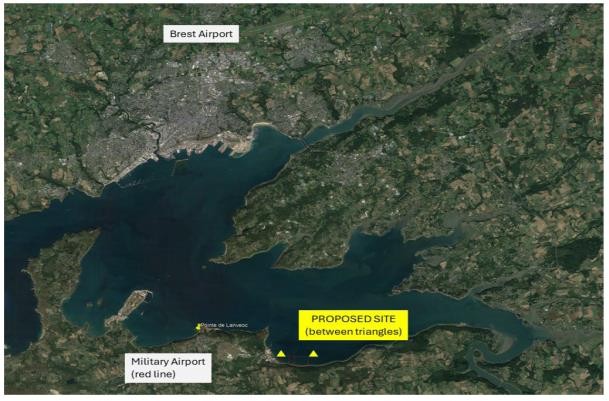
ABOVE: Location of proposed Sea Shepherd France orca sanctuary in Brest, France. SOURCE: IGEDD
BRIEF SUMMARY
- Due to actions by the French government, two orcas and twelve dolphins, are now stuck in dilapidated tanks at a French theme park
- A Spanish CITES decision may have paved the way for sanctuary NGOs to take possession of the animals.
- The holdup of permitting on a Greek dolphin sanctuary may be related to anti-NGO rhetoric from a Greek zoo.
- A temporary transitional tank should have been in consideration for the French cetaceans, but it may be too late.
The French government has decreed that two orcas and twelve dolphins are to remain in their deteriorating tanks at Marineland Antibes for the time being.
We didn’t need to reach this point. We previously reached it in Miami, and now we’re here again.
In addition to turning down NGO sanctuary proposals in Nova Scotia and Brest, France, there had been four proposed transfers of the park’s orcas. Early discussions started in 2017 to move the orcas to new facilities in Dubai and Hainan, China were discontinued due to the receiving facilities still being in the planning stages and eventually being postponed or cancelled. Proposed moves to Japan and Loro Parque, in Spain’s Canary Islands, off the west coast of Africa, were both denied this year by the French government.
This latest denial is surprising. The announced plan had been for the two orcas, along with two dolphins, to be transferred to Loro Parque, with the remaining dolphins going to Zoo Aquarium Madrid. The transfer should have been easily executed, since the Madrid facility is owned by the same company that owns Marineland Antibes – Parques Reunidos. The only requirement for the transfers to Madrid and Loro Parque would be health certificates for the animals issued by the French government. A CITES certification should not have been necessary as the transfers would take place between European Union member nations.
The announcement of France’s denial came one day before the planned transfer. A statement was made by an unnamed member of the Ministry of Ecological Transition to AFP stating that the “Spanish scientific agency that evaluates the suitability of facilities” had determined that the pools in both facilities “did not meet minimum standards in terms of area, volume and depth.”
This matter was poorly handled by the Ministry of Ecological Transition. The anonymity of the source at the French ministry, along with the anonymity of the Spanish agency, made it appear as if the Ministry was hesitant to make this information public. In fact, Agnès Pannier-Runacher, the Minister of Ecological Transition, was on a visit to Reunion Island, a part of France 400 miles east of Madagascar in the Indian Ocean, when the AFP ran the piece, and did not issue a public statement herself. By all appearances, she appears to have tried to distance herself over the past year from the Marineland debacle that she inherited from her predecessor.
Likewise, Loro Parque kept its response curt, responding directly to the AFP, with nothing about the decision on its website or social media posts. A video interview with Loro Parque founder Wolfgang Kiessling, published after the denial, showcases him touting the park’s record for animal welfare, but with no discussion on tank size. And it’s no wonder, as Kiessling and the park are attempting to minimize controversy with a new orca calf in its custody.
Numerous social media posts report that it was the Spanish CITES authority that issued the report on the facilities. I have reached out to the French Ministry of Ecological Transition, along with the four different Spanish authorities with CITES oversight, but have not heard back as of the time of this post’s publishing. As mentioned above, CITES authorities should not have been involved with a transfer to Spain, as the only requirement would be a health certificate issued by France’s DDPP (Direction Départementale de la Protection des Population). I won’t speculate on why an assessment was made of the Spanish parks by what may have been a CITES authority because I simply don’t have an answer as of now, but a denial of either a CITES permit or a health certificate, along with the denial of Marineland management to agree to participate with NGOs, is a prerequisite for the government authorizing the animals go to a sanctuary.
Let’s assume that the Whale Sanctuary Project or Sea Shepherd France were to be awarded control over the cetaceans by the French government. Following the death of Miami’s orca Tokitae in a dilapidated tank under the care of an NGO, all it would take would the be the death of a single animal, even a dolphin, for the marine mammal park and aquarium industry to strike, utilizing the death as an example of poor husbandry by “animal rights extremists.” Such a move could easily set back the already delayed sanctuary movement by years, complicated by numerous proposed facilities still in the permitting and/or site selection process after a decade, and, due to health and logistics concerns, what should be an outdoor beluga sanctuary in Iceland operating as an indoor swimming pool for whales.
I do not use the term “animal rights extremists” lightly. The Sea Shepherd France coalition has suggested moving the Marineland Antibes dolphins to a proposed sanctuary in Lipsi, Greece. The proponents of the sanctuary state that once permits are received, the netting can go up within sixty days and the sanctuary can be fully operational.
This is where we have a perfect example of the industry using the term “animal rights extremists” to define NGOs developing sanctuaries. In a claim that was echoed by the Greek press, the Attica Zoo stated that it was losing its dolphins due to the lobbying of “animal rights extremists” who want to send the animals to their own sanctuary in Lipsi (the old control the animals, control the message trope).
To counter this, the zoo proposed a move of its dolphins from the Athens suburb of Spata to the Clearwater Marine Aquarium in Florida, and the purpose has been positioned in different ways by the differing parties. Clearwater claims it to be a rescue effort since the dolphins will need somewhere to live, while the zoo is stating that the only reason for the proposed move is because the “animal rights extremists” who are forcing the dolphins out have nowhere to place them and therefore, the only place they can go, thanks to the “animal rights extremists,” is Clearwater. While I don’t know the reasoning behind the Greek government’s denial of permitting Lipsi, it is evident that the zoo and its supporters may have played a role in this decision based on its rhetoric about the removal of the Attica Zoo dolphins.
One of my main concerns about the French cetaceans is the very likely possibility that the party that maintains the animals in the Antibes facility (until an alternative is in place and approved by the French government) will employ the lowest possible cost solution for maintaining the pools and the animals. After all, it is only a temporary solution. I’ll explain my concern in a moment, but first, I’d like to present a possible alternative that seems to have been overlooked as unnecessary and too expensive – the temporary transitional tank.
The first thing to take into consideration when discussing a temporary tank is to throw out any discussion of Keiko’s tank at the Oregon Coast Aquarium. I’m not talking about a public display tank. I’m not talking about something built at an aquarium. I’m not even talking about the architectural and construction design of Keiko’s tank.
It’s time to forget about the Free Willy Project as a template. It’s time to think out of the box.
New architectural and construction methods and technologies developed within the last decade can deliver a transitional tank for a fraction of the cost and time it took twenty years ago. If an organization is smart at marketing, it could even get the French or European architecture and construction industries to subsidize the tank as a demonstration project. A temporary transitional tank was not employed for Tokitae, who died in her dilapidated existing tank. It should have been considered for the Antibes orcas and dolphins a year ago.
And here’s why I’m concerned. I feel that, with the months it will take for design and build, it may be too late for a transitional tank project to be implemented.
Because if what I’ve heard from a number of sources associated with Marineland Antibes’ parent company is true, the stability of the infrastructure of the pools and life support systems, and the health of the animals, is much worse than what the public is hearing.
Unless someone call pull of a miracle, these animals are in their final days.

