
Has the Nova Scotia government approved or authorized construction of the sanctuary?
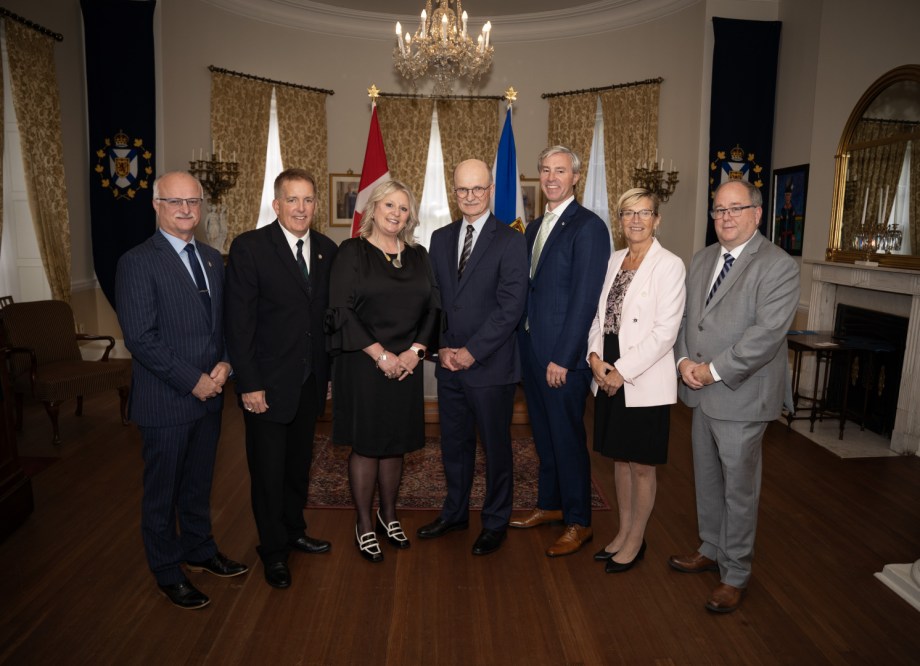
No. As of this writing, no member of the Nova Scotia cabinet (above photo), which authorized the issuance of the lease, has issued such a statement. Neither the government of Nova Scotia nor its Ministry of Natural Resources have released press releases with such statements. Social media accounts belonging to WSP board members Lori Marino and Naomi Rose refer to the approval of the lease, as does the organization’s Executive Director Charles Vinick in an article by Canadian Press reporter Michael MacDonald, but none state the overall project has been approved, rather that the lease clears the path moving forward.
Statements that the construction of the sanctuary has been approved or authorized erroneously appear in a number of legacy media reports as well as postings by WSP ally Animal Justice.
So what was approved?
The Order in Council (OIC) authorized the Department of Natural Resources to issue a 20-year lease to WSP for submerged and terrestrial Crown lands at the sanctuary site. Based on email correspondence in a 2022 Freedom of Information (FOI) release, the Crown lands include shoreline up to the high water mark and the entire landmass of Barachois Island, which forms the Southeast tip of the sanctuary plot. The OIC is not an issuance of the lease, but rather an authorization for the lease to be issued.
What else needs to be done?
According to WSP board member Naomi Rose: “All the federal and provincial reviews follow on from the Provincial Crown Lands lease, which has now been approved. We have completed all the required environmental assessments. We will also need local building permits from the Municipality (which is supportive) for construction in the designated sanctuary zone. And of course, every whale that comes to the sanctuary in future will need federal transfer permits . . . . None of those other steps could happen at all until the land lease was granted.”
Will having the lease expedite the permitting process?
Perhaps. We will have to wait and see.
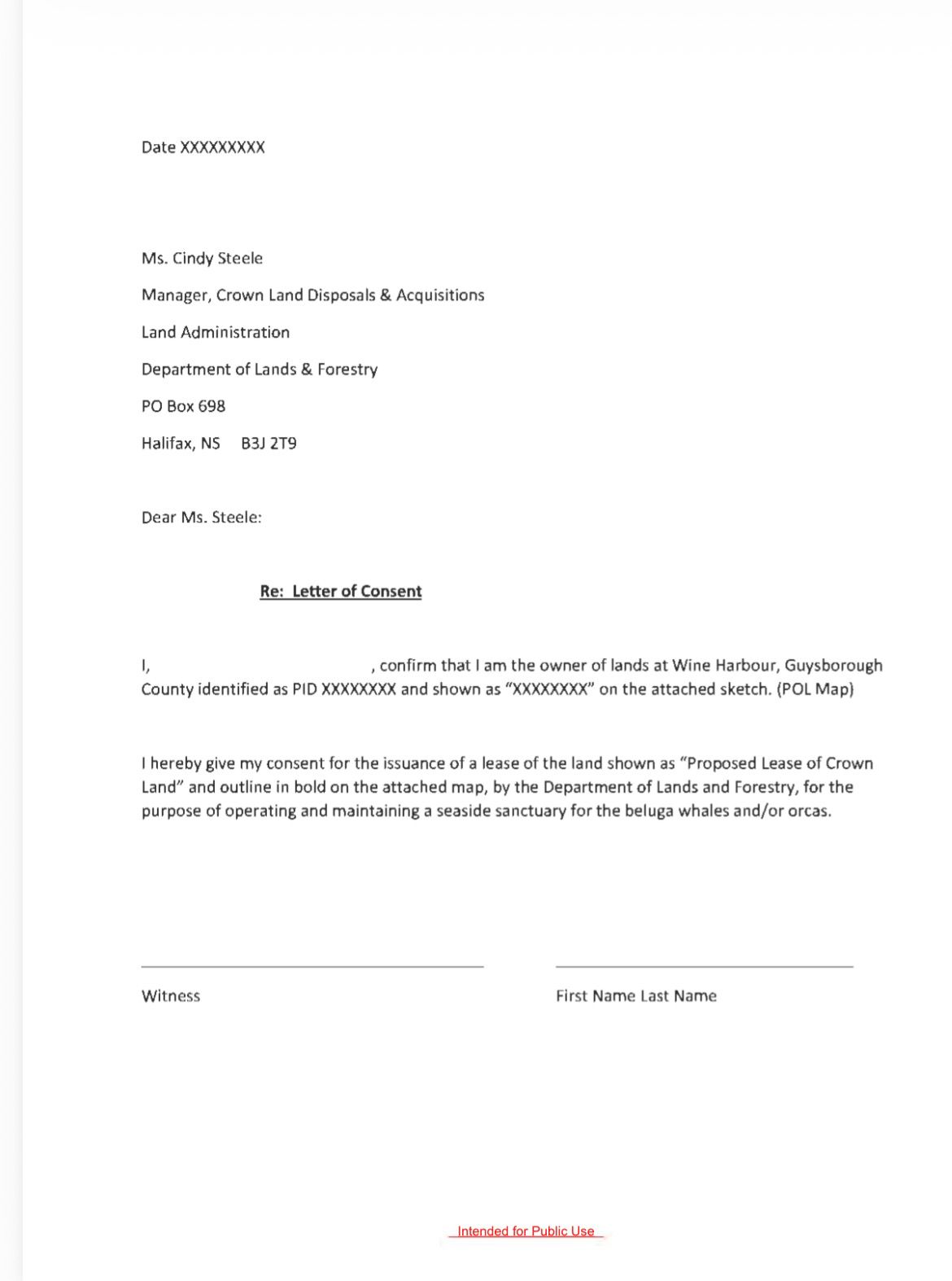
What happened to the landowner’s consent?
The OIC overrode the consent of local landowners required for the Crown lease. According to landowners I spoke with, they were neither consulted on nor informed about the decision, finding out through posts on social media.
Can the landowners sue?
Yes. However, and I am not speaking on behalf of the landowners here, but out of my own assessment of the situation, suing at this point would place them in a precarious situation due to the need to resolve the MarineLand Canada beluga crisis and WSP positioning itself as a solution. There may also be grounds for a broader lawsuit under the premise of landowners’ rights being violated in general.
Is this eminent domain?
Technically no. Eminent domain is typically executed for infrastructure improvement, road construction, government facilities, schools, parks – basically anything that is for the public good. The sanctuary is a privately owned facility and has refused government funding (see below). There is another usage for eminent domain which does apply to privately funded projects if those projects are expected to have a large economic impact upon the local community. However, neither WSP nor the local government have ever publicly released an economic impact study.
What about funding?
WSP is still seeking funding and has yet to publicly release any sustainable business plan for its first five or ten years of operations. Such a report would show how the organization intends to pay for construction and operation of the sanctuary for an extended period of time without seeking out emergency funding. This is of paramount concern as three of WSP’s four board members were in management positions during the rehabilitation and release of the orca Keiko, a project which experienced significant financial hardships after its primary donor reduced and eventually ceased financial contributions.
By our estimate, WSP has earned close to $10 million in revenue since its incorporation in 2016. The majority of those funds have already been spent. I also estimate that WSP could have between $10 million and $20 million in pledged restrictive funds from high worth donors – funds that become available only when certain milestones, such as permitting, construction, or animal acquistion, take place.
Is there a way to find out exactly how much WSP has to spend on the sanctuary?
WSP does not make its audited financial statements public, nor does it issue an annual report showing spending patterns and high value donors. What it does make public is its Form 990 tax returns, which lately have been raising red flags.
For example, in 2022 and for the early part of 2023, WSP was acting as fiscal sponsor of Friends of Toki. As fiscal sponsor, it received donations on behalf of Friends of Toki and then either paid expenses for or issued corresponding funds to the Florida-based nonprofit. According to WSP’s 2022 tax return, Friends of Toki founder Pritam Singh had been issuing a number of donations to WSP. According to tax law, these donations should have been placed in an expense account specific to Friends of Toki and those funds then used for the Florida project, and it should have been listed as expenses for its own program – the fiscal sponsorship.
Instead, what we do have in the tax return appears to show that Singh made his donations, those funds were apparently merged with donations from others intended for the Nova Scotia sanctuary, and then funds were taken from the combined revenue from Singh and other donors and sent to Friends of Toki. Not only is this highly unethical, it may also be illegal. But that’s not for me to say. That’s up to the myriad of law enforcement and regulatory agencies currently investigating both WSP and Friends of Toki.
If this is actually the case, the tax filing artificially inflates the funding for the Nova Scotia sanctuary and reduces the amount by rerouting donations to another nonprofit for a separate project.
Why doesn’t WSP accept government funding?
There are a number of reasons why a nonprofit would not want to accept government funding. It could delay development on the nonprofit’s project. It could require it to make its documentation and finances public or, if not required to be released directly by the nonprofit, such documentation could become public domain through an FOI filed with a government agency.
Was there a “quid pro quo”?
Did WSP offer the Nova Scotia government something in exchange for the bypassing of the local owners’ consent? This is what we know.
Just before the CIO was issued, there was a shuffling of the Nova Scotia Prime Minister’s cabinet. Among those ousted was Natural Resources Minister Tory Rushton, whose agency is in charge of issuing the lease of Crown lands to WSP, replaced by Kim Masland.
Within the press release issued by the Nova Scotia government sits this paragraph:
“I want to turn Nova Scotia into an energy superpower,” said Premier Houston. “Responsible resource development will power our economy for generations, combat poverty and help Nova Scotians earn more money.”
By pure chance, Whale Sanctuary Project’s financial records, according to its tax returns, are kept at the offices of a renewable energy company.

