
by Joe Kleiman, The Flip Editor
Before I begin, a brief disclaimer.
- I have no objections to sanctuaries. I have long supported sanctuaries and animal rescue organizations, including financially.
- I have no objection to The Whale Sanctuary Project (WSP) itself. My concerns stem from four key problematic business aspects of the operation:
- An ineffective board structure
- An Executive Director with a documented history of losing significant funding and poor management of physical projects
- A failure to successfully raise funds for a $15-20 million start-up cost on construction and animal acquisition and an additional operational cost for full capacity operations over a twenty year period of up to $100 million (at a predicted max of $5 million/year).
- A failure to have proper milestones or SMART goals, continuously pushing back completion dates.
- I commend Dr. Lori Marino for taking the initiative to found WSP, but somewhere along the journey, she and her cohorts lost their way.
Dr. Marino, President of WSP, has written a new blog post wherein she places the blame on the current marine park crisis exclusively on the exhibition industry. I get it. I presented a similar argument on The Flip Facebook page. But there’s one major point on which Dr. Marino is just wrong and there’s plenty of evidence to contradict her claim that: “Animal welfare advocates, governments, the general public, and the media should reject the narrative that they are to blame for the current problems facing captive dolphins and whales.”
Governments are certainly to blame. Delays in evictions, removal of animal welfare protections, finger pointing (“not our responsibility, their responsibility”), failure to confiscate, failure to issue transfer permits to other parks or even permits for sanctuaries – we have documented these actions taken by governments in the US, Mexico, France, Greece, and Canada.
Animal welfare advocates are certainly to blame. It may have been possible to transfer the whales and dolphins out of Antibes to another facility with a contractual obligation that the move be temporary until a sanctuary was ready, but lawsuits from WSP’s partner One Voice prevented such a move, keeping the animals in deteriorating tanks (something WSP’s Executive Director is quite familiar with and appears to prefer as seen by his work with the Miami Seaquarium). The fact that the Antibes facility is subpar should be no surprise to anyone. It’s been well known for some time within the zoo and aquarium community and if the deaths of two orcas within a few months of each other don’t raise a red flag, well then someone has horse blinders on.
Dr. Marino over the years has accused Canadian activists that have jumped ship on their support for blaming her for the death of Marineland’s orca Kiska.
In a way, WSP is responsible. Had they kept an open door policy, and just stated we can take this number of belugas and this number of orcas, all would have been fair. But the organization’s fundraising is dependent on naming specific whales and naming specific parks, with website and social media posts that chastise the parks for their treatment of their wards. Remember when WSP applauded Eduardo Albor and The Dolphin Company for being the rare park owner to partner with an NGO on the care and return of an orca? Look where we are now. WSP has been very quiet about The Dolphin Company’s bankruptcy, circumventing their partnership (and yes, Friends of Toki’s finances were being managed by WSP, no matter how much the WSP board members like to present that as inaccurate – it’s right there in the tax filings). Wow. I understand the need to maintain binding agreements, even after the unfortunate death, but the silence is deafening. For an organization that states it is assisting with solutions for dolphins in Belgium, much could have been done by WSP to bring awareness and solutions to the hundreds of animals owned by The Dolphin Company, but that ship has sailed.
In 2017 Charles Vinick, the Executive Director of Whale Sanctuary Project, conducted a TEDx talk, in which he stated that they anticipated on having their first resident in a Pacific Northwest sanctuary by 2019. That sanctuary never happened, and in 2020, a new location in Nova Scotia was announced. I’ll note that original plans called for two locations – orcas in the Pacific and belugas in the Atlantic. Eventually, those two concepts were combined and the opening date was pushed back year after year – 2022, 2023, 2024, 2025, and now 2026.
Here’s the interesting thing. Vinick has pointed out that WSP is using stretch goals – which, by good business practices, should really be used by successful organizations wanting to diversify profit centers. This means WSP has been operating without dated milestones on its project. Yet we keep seeing these dates. And that’s a problem, because though WSP has no true completion dates, it must advertise dates in order to raise funds. The sooner the date, the greater the urgency. Combined with the naming of candidate whales it does not have agreements on obtaining, stakeholders – the donating public – are given false hope and their financial and other support goes to WSP instead of other, more viable solutions. It’s not a scam. But it’s not entirely honest. And going back to Kiska, WSP’s push for her as a candidate resulted in mention of her potential move to the proposed Nova Scotia sanctuary in the introduction to bill S-203, which ended whale captivity in Canada. That part of the bill was a hell of a marketing push for WSP, which resulted in nothing more than a whale dying in her tank.
I could argue that WSP is currently playing a long game. In 2018, it approached Marineland Canada asking for the donation of Kiska and up to six belugas. It was turned down, the park released a disparaging report on the group and its sanctuary location. Then communication ceased. And I can argue that WSP, knowing that the park would soon cease operations, waited patiently in the shadows for the right time, fully aware that through its inaction it was artificially creating a crisis that it could then use to pressure government officials into approving and expediting its sanctuary.
I could argue that, but I won’t. Because there’s enough evidence to show that WSP is just as responsible as the owners and the government in creating this fiasco, by building expectations and promising a solution that has, to date, never materialized in a timely manner. To this date, almost a decade after founding ,WSP has placed no whales in a sanctuary nor has possession of any to do so. That places them way behind SEA LIFE Trust, National Aquarium, and even Ric O’Barry.
Next week, I’ll be going in depth into WSP’s business issues. Grab the popcorn.
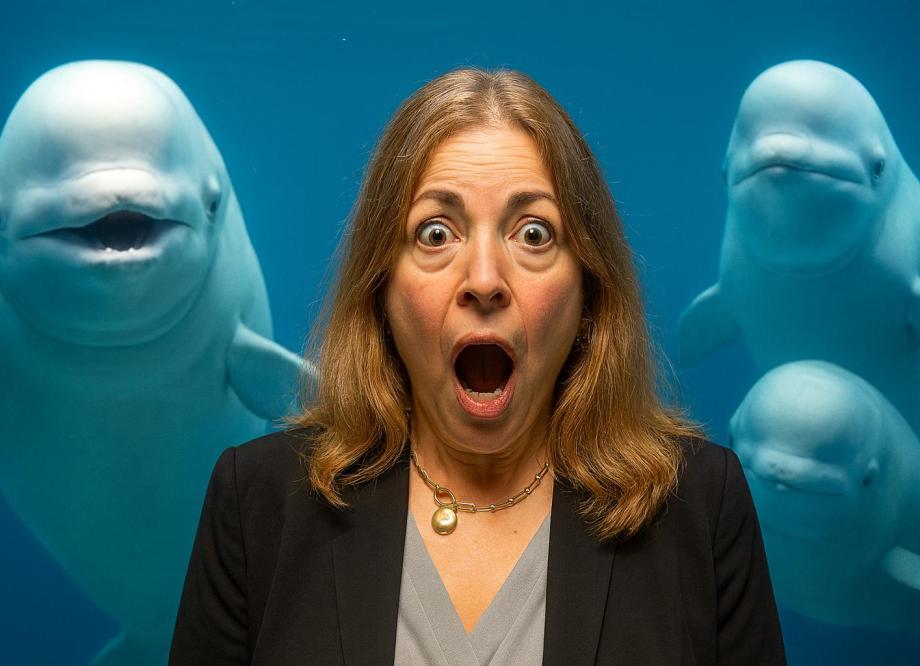
IMAGE is AI generated. Deal with it. Emotion portrayed may not represent Dr. Marino’s current state of mind.

