
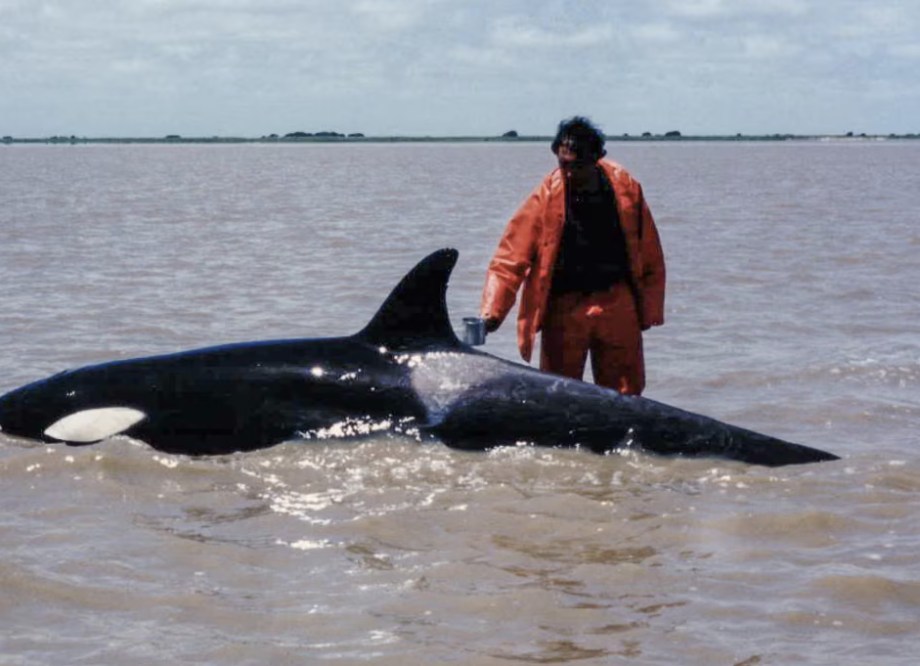
This piece originally appeared as part of the ThemedReality blog post Who Killed Kiska? PHOTO: A rescuer tries to keep Kshamenk wet while waiting for more help to arrive, 1992. Courtesy Mundo Marino.
Kshamenk is an adult male killer whale held at Mundo Marino S.A. in San Clemente del Tuyu, Buenos Aires Province, Argentina. The animal was rescued from a stranding. The following account was provided by Mundo Marino: On November 7, 1992, one killer whale was found stranded on the coast of Salinas Stream, in Samborombon Bay. Mundo Marino rescued it, but the whale died within a few hours of transport. In the afternoon of the same day, fishermen observed four killer whales stranded in “Rio de Ajo”, another location within Samborombon Bay. The next morning (November 18), Mundo Marino explored the site and found only one killer whale stranded. They could not move the whale because the extreme low-tide and waited until the tide rose sufficiently to attempt the rescue. Tidal conditions became favorable the next day and on November 19, the whale now known as Kshamenk was brought to Mundo Marino.
Our examination of Kshamenk’s medical and husbandry records suggests that since his recovery from the stranding episode, his health has generally been good and he has grown normally. At the time of stranding, Mundo Marino estimated his age at approximately three years. However, based on the time that he reached sexual maturity and his current size and stage of development, we believe that he must have been at least five years old when he stranded, making him a minimum of 19 years of age at present. Kshamenk sired a calf by a female killer whale (Belen) in 1997. The calf was stillborn in November 1998, and Belen died in February 2000. Since that time, Kshamenk has had no contact with other killer whales. He formed a close bond with a bottlenose dolphin (Floppy) shortly after Belen’s death, and the two have been held in the same pool ever since. They continue to be strongly associated, and according to the staff at Mundo Marino are never separated. As with most adult make killer whales in captivity, Kshamenk’s dorsal fin is permanently curled to one side.
– “Assessment of the Current Status, and Recommendations Regarding the Future of the Killer Whale ‘Kshamenk’,” Geraci, Huff, and Barrett-Leonard, 2006
Rumors began circulating about the four orcas and a possible forced stranding. Perhaps the transient pod did find themselves stranded, however the more likely scenario was that the local oceanarium saw an opportunity to increase their orca collection, rather than help release the dolphins back out to sea. It was a story with various renditions but the oceanarium Mundo Marino had been known to force animals into stranding situations in order to capture them for display. At the time, the facility had just one other orca thus, the transients would have provided the perfect opportunity to expand their captive population.
– “Kshamenk: The Forgotten Orca in Argentina,” Ric O’Berry’s Dolphin Project, 2018
Regardless of whether the capture was a rescue or an orchestrated stranding, what happened next is a textbook example of what happens when good intentions create undesirable conditions. In 2001, Mundo Marino orchestrated a breeding agreement with Six Flags, a North American theme park chain. The American company had just purchased the SeaWorld Ohio property and were integrating it with a neighboring theme park. In 2002, Shouka, born at Marineland Antibes in France, was flown out to the Ohio property. The plan was for her to be joined by Kshamenk, both of whom were on the same approved NOAA import permit.
According to Gabriela Bellazzi of Wild Earth Foundation (WEF), while NOAA Fisheries issued an import permit, the Director of CITES in Argentina was persuaded to deny an export permit on the grounds that private ownership of wildlife was illegal in the country and that a move of Kshamenk would require a transfer of ownership to the aquarium, setting in motion a “negative precedent.”
Bellazzi wrote in a 2013 document: “In 2002, together with the Free Willy‐Keiko Foundation and Earth Island Institute, WEF submitted a proposal to retire and rehabilitate Kshamenk as an alternative to his transfer to Six Flags. Different locations in three Argentine provinces were assessed and an evaluation of Kshamenk’s health and mental status requested, in order to know whether he was a good candidate for release . . . . While holding Kshamenk in a sea pen would provide him with a larger and richer environment that would allow him to engage in natural activities, such retirement plan is likely to fail in the current situation. The costs for a long-‐term care are excessive, and, mostly important, there are no adequate locations near the oceanarium or near the area of Kshamenk’s stranding, which would ensure protection from storms and other natural threats.”
It’s here that connections can be made. Free Willy-Keiko Foundation operated as part of the International Marine Mammal Project, which is part of Earth Island Institute (EII). So, Free-Willy Keiko and EII were one and the same organization. And they both operated under the same management – most notably, David Phillips, a founding board member of the Whale Sanctuary Project.
My guess is that at the time, in 2002, EII did not have the financial infrastructure to maintain two costly whale relocations and rehabilitations, especially as its primary donor on Keiko, Craig McCaw, had significantly reduced his funding the prior year. So while EII was busy working with Keiko, Kshamenk was being set up to live more than a decade without another orca. As a result of the failure to relocate him to Ohio, Shouka also lived a decade without another orca, in both Ohio and later the San Francisco Bay Area. It is true that both had bottlenose dolphin companions. While Kshamenk was, by all reports, friendly with his dolphin companion, the same could not be said of Shouka. After exhibiting aggressive activity, she was physically separated from the park’s dolphins. On the surface, it appears this may constitute a violation of § 3.109 of the Code of Federal Regulations, as established under the Animal Welfare Act (cetaceans must be with a companion of the same species or a companion that is similar biologically). However, there are provisions for exceptions in the statute when proximity to another similar animal might result in physical or mental harm to the animal in question.
In 2012, Six Flags and Marineland of Canada were in discussions for Shouka to become a companion to Kiska, replacing Ikaika, a loaned breeding whale who had been repossessed by SeaWorld.. But Six Flags didn’t own Shouka. She had been sent to Ohio on breeding loan in 2002 with the full expectation that she would be paired with Kshamenk. Her owners, Spanish theme park firm Parques Reunidos, through its American subsidiary Palace Entertainment (the same Palace Entertainment that in 2014 would buy the Miami Seaquarium and Lolita/Tokitae), engaged its lawyers to prevent the transfer. Nine months after Ikaika’s arrival at SeaWorld San Diego, Shouka arrived at the same park. Were Shouka and Ikaika intended to mate? Perhaps. But in 2016, SeaWorld ended its breeding program.
As Shouka ended her decade of loneliness, Kshamenk would continue his life without another orca, and with Bill 80 receiving Royal Consent on May 28, 2015, no further orcas would be permitted for import into the Provence of Ontario. Kiska would live her final eleven years alone in her tank, without another orca, or even a bottlenose dolphin.

