
By Joe Kleiman, The Flip’s flippin’ Editor in Chief
This is one of those posts where I’ve been adding so much while writing it over the past few weeks that it’s reached 50,000 words. So instead of a single post, I’m cutting it down to a series of smaller posts that will run on the evening of February 20 (this one) and throughout the weekend on February 21 and 22.
The post started out as a response to a comment by Lori Marino, Founder and President of Whale Sanctuary Project, which on February 13, she placed online on WSP’s Facebook account:
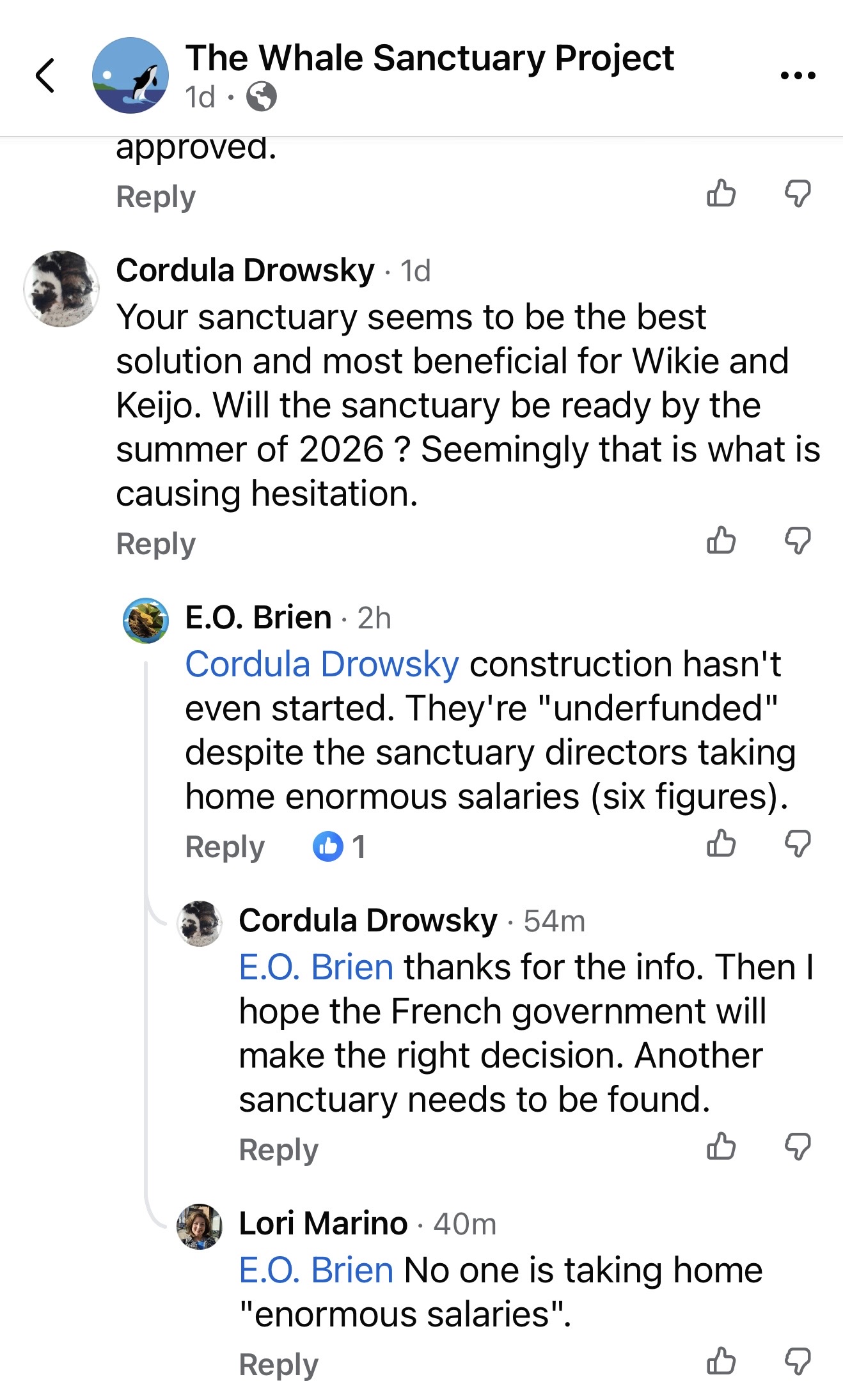
So, I decided to look into the salaries, to see if they actually were enormous. I’m well suited to this kind of investigation. I majored in marine biology in college, but I’m not a marine biologist. I volunteered at zoos, but I’m not a professional zookeeper or animal trainer. My expertise is the business and marketing of companies and organizations. Fifteen years ago, I started professionally reporting on themed entertainment design for a number of trade publications. Prior to that, I spent twenty years in various management positions within the attractions industry, ten of those with nonprofits. I served as a marketing and sales manager, an operations manager, and in D- and C-level positions. A major portion of my work involved accounting. I also served on a number of nonprofit boards and on industry association committees.
The last position I had before switching over to journalism, which I absolutely love, was as Director of Attractions for a $108 million military museum, which I joined while it was still in the construction phase. I estimate WSP’s projected cost for buildout and the first five years of operation at $30 million. That’s small fry compared to the new build projects I’ve been involved in. Just including the IMAX theaters I’ve managed, the annual revenue has been between $3 million and $7 million, not including grants from foundations and government agencies and corporate sponsorships that I was able to procure in conjunction with our development managers – for those of you who don’t know, development managers are professionals whose whole job is centered around fundraising for the organization.
That’s why if you ask me whether the salaries are enormous, and this might surprise you, my answer is “We don’t know.”
We can’t tell because of two factors.
- WSP has never released its staff salaries. What some believe to be salaries listed on the IRS form 990 is actually compensation, which is made up of a number of different things, including salary, bonuses, benefits, incentives, vehicles, meals, sick leave, and a few more other things. This is why we see an ebb and flow in the compensation amounts and why one year it could be up and the next down – it’s most likely not variations in the salaries, it’s all the other stuff added to the salaries that creates the compensation amount.
- WSP does not release audited and itemized financial reports, like many other sanctuary organizations, which would break down the compensation in detail.
Method
So how do I approach an investigation of WSP? I follow one simple rule:
It’s not what they say. It’s how they say it.
Studying this organization is like putting together the pieces of a puzzle, but it’s more like that puzzle my wife bought for me on Amazon, which came from some firm in Chengdu that failed to properly cut the jigsaw pieces, so a number of them just don’t fit where they should. Yeah, WSP is like that. So I start with what they say, then I examine how they say it, then finally, I look at the gaps and figure out what they’re NOT saying.
Origins
To understand WSP, it’s important to examine its origins. I’ve determined three key points where three different timelines begin, eventually intersecting to form Whale Sanctuary Project:
- The incorporation of the Process Church of the Final Judgement, New Orleans, 1968: This is the beginning of Michael Mountain’s journey, as the religious order became a company. Mountain would apply the Church’s methodology for public relations and fundraising to Whale Sanctuary Project, which he co-founded with his partner Lori Marino.
- The merger of the Jean-Michel Cousteau Institute and the Free Willy Keiko Foundation in 1999, forming Ocean Futures Society: Jean-Michel Cousteau, Charles Vinick (WSP board member and its second Executive Director – now CEO) and David Phillips of Earth Island Institute (now a WSP board member) are all operating under the same umbrella.
- Steven Wise’s amicus filing in Tilikum vs SeaWorld in 2012: There were a lot of famous activists and welfare advocates involved with this lawsuit against SeaWorld, but it was the amicus filing from the founder of the Nonhuman Rights Project that I count as the beginning of the timeline for NhRP’s scientific advisor, Lori Marino, and her colleague Naomi Rose. Between Tilikum vs SeaWorld and the establishment of WSP, of which both are founding board members, the two would advise on and promote the film “Blackfish” and David Kirby’s book “Death at SeaWorld.”
My colleagues and I have been collecting a lot of background material which places WSP’s actions into focus. We’ll be sharing this information in the weeks ahead.
Scam
Is WSP a scam? If it is, and that’s for the legal authorities to decide, not me, I don’t think it started out that way. I think it started out as a well intentioned idea by a group of passionate individuals. But somewhere around 2019, about the time that plans for an orca sanctuary in Washington were abandoned and the group was searching desperately for a location in Nova Scotia, something changed. Tax filings, which are the only financial documents the organization makes public, began showing inconsistencies. As someone that has been involved with construction of new long-term projects and who has worked in marketing, outreach, procurement, and daily operations, I noted that starting in 2020, a number of figures were appearing to be overinflated when compared to the expense descriptions. I’ll be going over that in detail in another post.
Let me explain my thoughts on WSP in a way that Lori Marino would understand. In the United States, corporations, including nonprofits, are legally considered “people.” So I’m going to consider Whale Sanctuary Project as a non-human person, like an orca at a theme park.
Let’s say that orca was imported under a permit that prohibits commercial exhibition and breeding, but the park operators are having it perform in theatrical shows to Pointer Sisters tunes, and they’re attempting to breed it so they can sell the calves to a park in China.
Whale Sanctuary Project is that orca. It was established to create and operate sanctuaries. That’s its mission. But there’s no sanctuary. It’s not Sea Life, which already owned its whales when it built in Iceland. It’s not San Paolo, in Italy, which is ready to go pending some last minute adjustments and permitting. Those are sanctuaries that exist. For a decade now, the public has waited. And now, they wait some more, and the whales wait, and Non-human person Whale Sanctuary Project waits.
But it’s like Eduardo Albor and Tokitae. A whale that can’t make money but costs money is a problem. Same thing with the non-human person Whale Sanctuary Project. It’s treated like it’s stuck in a concrete tank, so it’s there for the pickings. So the six people in charge – Lori Marino, Michael Mountain, Charles Vinick, David Phillips, Naomi Rose, and, oh yeah, the man in the back of the room, Jean-Michel Cousteau, have a problem – they can’t get the money to build without having the whales and they can’t get the whales without confirmation they can afford to build a sanctuary – so they use the non-human person Whale Sanctuary Project like the park using an orca to line its pockets. Where the money actually goes, we don’t know.
SCHEDULING NOTE
We had originally planned to share newly acquired FOI documents on the MarineLand belugas in this post. Since we are splitting our original post into smaller ones, we’ll be sharing these documents tomorrow.

