
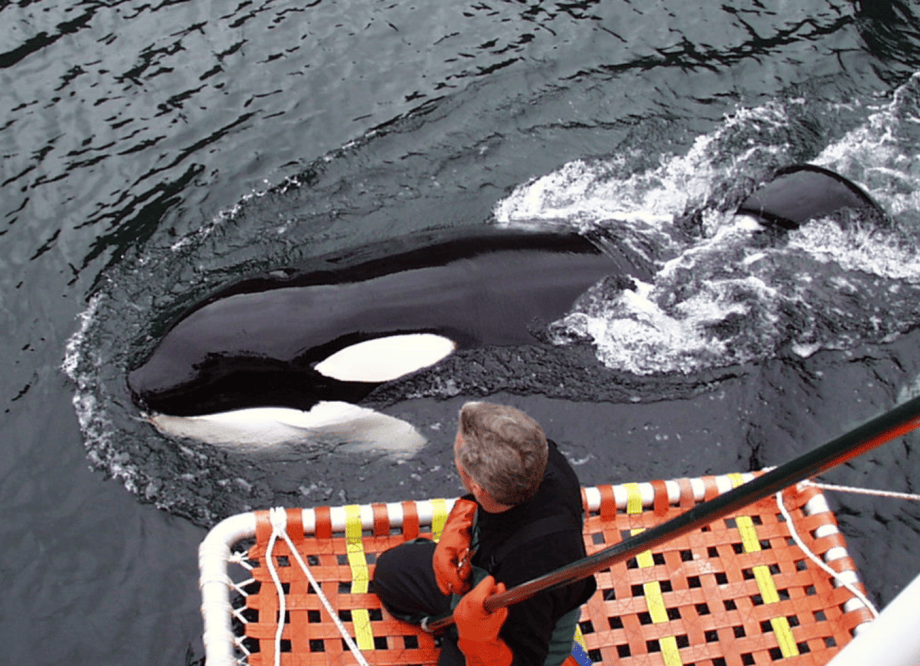
Over the past month, members of the Shadow WarriorsTM Initiative have made a number of visits to the University of California, Berkeley to review documents housed in the Earth Island Institute (EII) archives. We have found a pattern of business and operational procedures established by EII’s Free Willy Keiko Foundation that continues with its legacy NGO, Whale Sanctuary Project
What is the Shadow Warriors Initiative?
The Shadow Warriors Initiative was started in April 2023 by journalist Joe Kleiman and retired marine mammal trainer Valerie Greene. It is a volunteer coalition primarily focusing on improving welfare conditions for marine mammals in all captivity formats – be it exhibition, research and academia, military, rescue and rehabilitation, or sanctuary. The Initiative is also involved in improving physical and mental health and safety standards for the staff who are caring for these animals.
The term “Shadow Warriors” derives from the fact that much of what the Initiative accomplishes – including document procurement, assessment, and discussions with political and regulatory officials and others – is done out of public view, “in the shadows.” This is intentionally done to safeguard the integrity of investigations and protect the identities of Initiative members and sources. It’s important to note that the Initiative is an all-volunteer collective and not a registered non-profit organization. All expenses currently are paid directly by the membership, which, since 2024, has expanded to over a dozen Shadow Warriors in five countries.
The Shadow Warriors Initiative manages The Flip on social media as well as The Flip blog on ThemedReality.com as public information resources.
Rules of the Library
Residing within the special collections of the Bancroft Library at the University of California, Berkeley, are the archives of Earth Island Institute, with a timeframe from 1982 to 2008. Cartons 16-21 house original documentation from the Free Willy Keiko Foundation, which was later renamed Ocean Futures, following its March 1999 merger with the Jean-Michel Cousteau Institute.
Over the past month, we took a deep dive into cartons 16-18, which include documents on the establishment of both the Free Willy Keiko Foundation and Ocean Futures, the design and construction of the tank at the Oregon Coast Aquarium and the sea pen in Iceland, transport logistics from Mexico to Oregon and Oregon to Iceland, veterinary inspections (including medication lists) and water quality samples, training strategies, site inspection reports for the United Kingdom, Ireland, and three locations in Iceland, permits, and financial reports and fiscal concerns, among many, many other topics.
The library is very strict on how documents are to be touched and reviewed. In addition to our handling of the archives in the browsing room, there are other guidelines which directly impact how we will share information from the collection on this blog.
While we were allowed to photograph the documents for research purposes, we cannot, by library rules, publish those images in a public forum, including this blog and its accompanying social media accounts. However, we are permitted under the free use doctrine to cite and even quote the text of the documents we photographed. In accordance with the library’s rules, we are ensuring that any personal information we encounter in the archives – including non-work related addresses, phone numbers, social security numbers, and credit card and banking information – remain in the archives.
For those interested in seeing the documents in person, you will need to visit the Bancroft Library on the University of California campus in Berkeley. We confirmed that documents are not allowed off premises and cannot be sent to other UC campuses for review. City parking garages are located outside the campus, or you can take BART (the Bay Area’s subway) to the Downtown Berkeley station, about a half-mile walk from the library. Note that if you are out of shape, as one of our members discovered he is, the majority of the walk is uphill at a 45-55 degree angle. There is an electric cart service on campus, called The Loop, for those with disabilities or disability-related needs.
Information on the Bancroft Library, and how to access it, can be found at https://www.lib.berkeley.edu/visit/bancroft.
Because the archives are stored offsite and then transferred to the browsing room when ordered, specific cartons or boxes need to be reserved. We recommend doing so at least three weeks in advance as scheduling of the document transfer is dependent on the number of students available to execute the task.
An itemized list of the containers and folders that make up the EII archives can be found here: https://oac.cdlib.org/static_findaids/ark:/13030/c8v98fmv.html
We also highly recommend using the detailed timeline compiled by Howard Garrett, available on the Orca Network website: https://www.orcanetwork.org/keiko-life-story.
Not all of the files are in chronological order and we found having the timeline open on a laptop in the browsing room extremely beneficial in placing documents in context.
The surprise document
In carton 18, file 7, we came across an unexpected document. It’s not dated, nor does it state the author.
It’s simply titled “KEIKO REINTRODUCTION STRATEGIES.”
The document features four different scenarios, numbered in order from the most desirable to “less than ideal.” Each scenario is separated into pros and cons.
The first, most desirable option, is titled “Multiple animal release (wild animals),” and is called “the idea that probably has the greatest chance for success.” This concept was built around creating an artificial pod in a captive environment with which Keiko could be released. It called for the capture of wild non-mature orca in the Icelandic region, which would be kept in a large bay or fjord, eventually with Keiko being added to the group. Among the pros, according to the document, would be Keiko not only having a social structure, but also a pod structure within which he could learn hunting skills (we will note here that contradictory to this strategy, other documents in the archives indicate a significant reduction in Keiko’s food intake in order to “encourage” him to hunt live fish in his Oregon pool, something we will cover in a later post).
On the con side, the author writes: “Though I believe that this may be the best way to ensure Keiko’s release and integration back into the wild, others on the extreme side of things are against the capture of any animal. These same people want us to release him, but do not understand the concept of what is best or ideal for Keiko. In order to pursue the above concept we would need to spend a lot of money on educating everyone as to what we are doing, and have a very thought out plan that is approved by the environmental extremes.”
The second option involved acquiring a second North Atlantic orca from a park or aquarium, with the hope that the two whales would encourage each other to develop survival skills. The prospect of purchasing a whale from the Vancouver Aquarium (which dates the document as prior to 1998) is mentioned, as is purchasing from a Japanese facility. The cons primarily revolve around the cost of purchasing an additional whale (Keiko was donated to the Free Willy Keiko Foundation by Reino Aventura, but other documents in the archives list his valuation at $1 million), along with additional operating costs for expanded staff.
The third option was “Single Animal Release,” which although “not being the ideal situation, is feasible.” This is basically the plan that was attempted. This strategy called for Keiko to socialize with local residents, but for the sea pen to remain open and available should he want to return. One of the biggest cons listed was the “need to be prepared or provide for him (or them) ad infinitum.” We are not certain as to why the parenthetical plural is included (it appears on two other instances in the con section). We believe it either is a reference to option two, wherein both orcas would not successfully socialize with local whales and want to remain in the pen OR it could be concern that Keiko might influence wild whales to enter the pen to enjoy the freebies he enjoyed.
The final option was “Single Animal Release (AMF).”
We had to look up AMF. The title of this blog post is the first thing that appeared on on a web search, though there is a more family friendly version, “Adios, My Friend.”
We were so caught off guard by this section that we cannot do it justice through a summary. Here it is, quoted directly, in its entirety:
PROS: Though I believe this is not the way we should go, we need to discuss the matter. If the world falls down around us, or the sky blows up, we need options and this option is always there. Worse case scenario should be the reason we provide Keiko with as many skills as we can to help him succeed, should this happen.
CONS: We will probably be hunted down for the rest of our lives by the people who have followed the project. Our names will be on the most wanted list and Dateline NBC and 60 Minutes, along with every other news organization will be after us. This is certainly what I view as a no win situation and we should avoid it at all costs. We also have wasted a lot of time and money just to throw Keiko’s life away.
Image credit: Free Willy Keiko Foundation, EII

